|
|
|
|
|
|

|
Naval History by Country :
|
|||||||||||||
| VIEW ALL OF OUR CURRENT ART SPECIAL OFFERS ON ONE PAGE HERE | |||
| NAVAL ART | AVIATION ART | MILITARY ART | SPORT ART |
|
|
No.208 Sqn RAF |
|
Name : No.208 Sqn RAF Founded : 1st April 1918 Country : UK More Details : Vigilant |
Known Service Details : | |||||||
Pilot or Aircrew | Rank | Start of Service | End of Service | Known Dates | Aircraft | Airframes | Notes |
unknown | unknown | ||||||
flight commander | unknown | unknown | 04th June 1917 | ank of Flight Commander, During a brief posting with No. 208 Squadron, he used a Sopwith Camel to down his tenth and final victim on 6 April 1918 | |||
| Pilots and Aircrew for : No.208 Sqn RAF | ||
| A list of all aircrew from our database who are associated with this squadron. A profile page is available by clicking their name. | ||
| Name | Info | |
| Binns, Paul Click the name above to see a profile of Binns, Paul | Binns, Paul Jaguar pilot, No.16 Sqn. Flight Lieutenant Paul Binns joined the Royal Air Force in 1988 and completed his Officer Training at the Royal Air Force College, Cranwell. Following flying training on the Jet Provost and the Hawk, he was posted to Lossiemouth in 1990 to 237(R) Squadron, the Buccaneer Operational Conversion Unit. After his conversion course, Paul was posted to 12(B) Squadron to fly the Buccaneer S2B in the maritime Strike/Attack Role. When 12(B) Squadron re-roled, Paul was posted 208 Squadron to continue flying the Buccaneer. With the demise of the Buccaneer in 1994, Paul was posted to 6 Squadron at Coltishall, flying the Jaguar GR1A. He has flown on exercises throughout Europe, North America and the Middle-East in addition to flying on peace-keeping operations over the former Yugoslavia. In 1998 Paul completed the Jaguar Qualified Weapons Instructor Course and was posted to the instructional staff of 16(R) Squadron, the Jaguar Operational Conversion Unit at Lossiemouth. When not displaying, his job on the Squadron is to teach pilots to fly and operate the Jaguar. | |
| Botterell, Henry Click the name above to see a profile of Botterell, Henry
| Botterell, Henry First World War fighter pilot with the Royal Flying Corps. Born in 1896, Henry Botterell joined the Royal Naval Air Service in Canada, and in 1916 sailed for England where he trained as a pilot to fly fighters. In 1917 he was posted to France, joining an operational squadron on the Western Front, butan engine failure on his second take off brought his flying to an abrupt conclusion, forcing him to spend several months in hospital and convalescing back in England, where he was demobilised. After a chance meeting with pilots on leave in England with whom he had trained, Henry applied to rejoin the service and was accepted. Re-qualifying as a fighter pilot, in early 1918 he returned to operational combat flying in France with 208 Squadron Royal Flying Corps. Flying Sopwith Camels he saw active service with 209 Squadron for the remainder of the war until the Armistice in November. Staying in France as part of the continuing Force he eventually returned to Canada in 1919 - bringing back with him a fence post which the wing of his Camel had collected on one of his many low level sorties. The post now resides in the War Museum in Ottawa. Henry died in 2003. | |
| Gerrard, Thomas Francis Netterville Click the name above to see a profile of Gerrard, Thomas Francis Netterville
| Gerrard, Thomas Francis Netterville born on 13th August 1897 in Selangor, Malaysia. on 31 December. After transferring to No. 1 Naval Squadron, Gerrard was assigned to fly Sopwith Triplanes; he would score eight victories with them between April and June 1917. on 11th April 1915. He was awarded the DSC for recognition of his services during a flight on 4th June 1917 in the rank of Flight Commander, During a brief posting with No. 208 Squadron, he used a Sopwith Camel to down his tenth and final victim on 6 April 1918. On 30 May 1918, Gerrard was promoted to temporary major, and was served as commander of No. 209 Squadron He later transferred to the newly created RAF in 1918 and in total he was credited with ten "kills" with all the units he flew with; nine of the ten were as a pilot of the Sopwith Tri-plane. On 21 October 1922, he was transferred from the Central Flying School (Inland Area) to the No. 5 Flying Training School and from there was transferred to No. 1 Squadron RAF in Iraq on 23 February 1923. On 14 July 1923 Gerrard died from a cerebral haemorrhage in Mosul after a fall from his polo pony, and was buried at the Hinaidi RAF Peace Cemetery Baghdad. he was twenty four years old. | |
Known Individual Aircraft of No.208 Sqn RAF : | ||||||||
Type | Serial | Codes | First Flew | Squadron History | Aircrew History | History Notes | Engine | Factory |
- | no information | |||||||
- | no information | |||||||
- | no information | |||||||
- | no information | |||||||
- | no information | no information | Merlin 46 | Castle Bromwich Aircraft Factory | ||||
- | no information | no information | Merlin 66 | Castle Bromwich Aircraft Factory | ||||
- | no information | no information | Merlin 66 | Castle Bromwich Aircraft Factory | ||||
- | no information | no information | Merlin 66 | Castle Bromwich Aircraft Factory | ||||
- | no information | no information | Merlin 66 | Castle Bromwich Aircraft Factory | ||||
- | no information | no information | Griffon 65 | Aldermaston | ||||
- | no information | no information | Griffon 65 | Aldermaston | ||||
- | no information | no information | Griffon 65 | Aldermaston | ||||
- | no information | no information | Griffon 65 | Aldermaston | ||||
- | no information | no information | Griffon 65 | Aldermaston | ||||
- | no information | no information | Griffon 65 | Aldermaston | ||||
- | no information | no information | Griffon 65 | Aldermaston | ||||
- | no information | no information | Griffon 65 | Aldermaston | ||||
- | no information | no information | Griffon 67 | Aldermaston | ||||
- | no information | no information | Griffon 67 | Aldermaston | ||||
- | no information | no information | Griffon 67 | Aldermaston | ||||
- | no information | no information | Griffon 65 | Keevil | ||||
- | no information | no information | Griffon 65 | Keevil | ||||
- | no information | no information | Griffon 65 | Keevil | ||||
- | no information | no information | Griffon 65 | Aldermaston | ||||
- | no information | no information | Griffon 67 | |||||
- | no information | no information | Griffon 67 | Aldermaston | ||||
06/02/1946 | no information | no information | Griffon 67 | Aldermaston | ||||
- | no information | no information | Griffon 67 | Aldermaston | ||||
- | no information | no information | Griffon 67 | Aldermaston | ||||
- | no information | no information | Griffon 67 | Keevil | ||||
- | no information | no information | Griffon 67 | Aldermaston | ||||
- | no information | no information | Griffon 67 | Aldermaston | ||||
- | no information | no information | Griffon 67 | Aldermaston | ||||
- | no information | no information | Griffon 67 | Keevil | ||||
- | no information | no information | Griffon 67 | Keevil | ||||
- | no information | no information | Griffon 67 | Aldermaston | ||||
- | no information | no information | Griffon 67 | Aldermaston | ||||
- | no information | no information | Griffon 67 | Aldermaston | ||||
| Aircraft for : No.208 Sqn RAF | ||
| A list of all aircraft associated with No.208 Sqn RAF. A profile page including a list of all art prints for the aircraft is available by clicking the aircraft name. | ||
| Aircraft | Info | |
Atlas
Manufacturer : Armstrong Whitworth Production Began : 1927 Retired : 1935 Number Built : 478 | Atlas The first batch of 37 aircraft were ordered in 1927, entering service with 13 Squadron RAF and 26 Squadron in that year. Once the initial handling problems had been solved by the fitting of slats, the Atlas proved well suited to the army co-operation role, serving both at home and overseas, with 208 squadron, being the first squadron to operate Atlases outside Britain, replacing Bristol fighters at Heliopolis, Egypt in 1930. Atlases were also used for communications duties and as advanced trainers, with 175 dual-control models built. The Atlas continued in service in the army co-operations role until replaced with the Hawker Audax, a variant of the Hawker Hart, with the last operational squadron, 208, re-equipping in 1935. It was also replaced in the advanced trainer role in 1935 by the Hawker Hart Trainer. Four civil registered Atlas trainers were used by Air Service Training Ltd for advanced and reserve flying training. They were scrapped in 1938 | |
Buccaneer 
| Buccaneer The Buccaneer. Designed for high-speed, deep penetration attacks at ultra low level, the Buccaneer has always been immensely popular with its aircrews. The design may be old, but the concept was brilliant, and the Buccaneer still retains a unique combination of range, war load and speed, unmatched by any other aircraft in RAF service. Pressed into service during the Gulf War, Buccaneers finally proved in the most spectacular manner what many had known for years - that the only suitable replacement aircraft for the Buccaneer is another Buccaneer. | |
Camel 
Manufacturer : Sopwith Production Began : 1916 Number Built : 5714 | Camel SOPWITH CAMEL: was the most successful fighter of World War one. Claiming almost 3,000 air victories. The prototype of the Sopwith camel first flew in December 1916, and its first combat mission began in June 1917. joined 4 squadron RNAS based near Dunkirk. The first Royal Flying Corp squadron to receive the aircraft was no. 70 squadron. The Sopwith camel was the first designed fighter to have two forward firing machine guns. Its design gave it amazing maneuverability and aerobatic qualities. and was perfectly suited for aerial dog fighting. Squadron after squadron was re equipped with the camel and by the end of February 1918 13 squadrons were fully operational with the aircraft along the western front. Also used on the Italian Front with 3 squadrons equipped. This figure increased with a total of 19 squadrons equipped on the western front by August 1918. This included two squadrons no. 151 and 152 for night fighter duties. in June 1918. There was also a naval version of the Sopwith camel. the 2F.1s which gradually replaced the Sopwith Pup and other naval aircraft. The Naval version most memorable fete was done by Lt S D Culley who took off from a towed wood platform and destroyed the Zeppelin L.53 on the 10th August 1918. also on the 18th July six aircraft took off from the forward deck of HMS Furious to bomb the Zeppelin base at Tondern which they successfully did destroying two Zeppelins L.54 and L.60. This was the first time carrier borne aircraft had destroyed a land base installation. In total 5597 F.1s and 317 2F.1s were ordered but there may have been 200 less built. Performance. speed: 113mph at 10,000 feet. service ceiling 19,000 feet. Armament: two fixed forward firing Vickers .303 machine Guns. or one .303 forward firing and one .303 Lewis Gun | |
Hurricane 
Manufacturer : Hawker Production Began : 1936 Number Built : 14533 | Hurricane Royal Air Force Fighter, the Hawker Hurricane had a top speed of 320mph, at 18,200 feet and 340mph at 17,500, ceiling of 34,200 and a range of 935 miles. The Hurricane was armed with eight fixed wing mounted .303 browning machine guns in the Mark I and twelve .303 browning's in the MKIIB in the Hurricane MKIIC it had four 20mm cannon. All time classic fighter the Hurricane was designed in 1933-1934, the first prototype flew in June 1936 and a contract for 600 for the Royal Air Force was placed. The first production model flew ion the 12th October 1937 and 111 squadron of the Royal Air Force received the first Hurricanes in January 1938. By the outbreak of World war two the Royal Air Force had 18 operational squadrons of Hurricanes. During the Battle of Britain a total of 1715 Hurricanes took part, (which was more than the rest of the aircraft of the Royal air force put together) and almost 75% of the Victories during the Battle of Britain went to hurricane pilots. The Hawker Hurricane was used in all theatres during World war two, and in many roles. in total 14,533 Hurricanes were built. | |
Lysander 
Manufacturer : Westland Aircraft Production Began : 1938 Retired : 1946 Number Built : 1786 | Lysander The first Lysanders entered service in June 1938, equipping squadrons for army co-operation and were initially used for message-dropping and artillery spotting. When war broke out in Europe, the earlier Mk Is had been largely replaced by Mk IIs, the older machines heading for the Middle East. Some of these aircraft, now designated type L.1, operated with the Chindits of the British Indian Army in the Burma Campaign of the Second World War. Four regular squadrons equipped with Lysanders accompanied the British Expeditionary Force to France in October 1939, and were joined by a further squadron early in 1940. Following the German invasion of France and the low countries on 10 May 1940, the Lysanders were put into action as spotters and light bombers. In spite of occasional victories against German aircraft, they made very easy targets for the Luftwaffe even when escorted by Hurricanes. Withdrawn from France during the Dunkirk evacuation, they continued to fly supply-dropping missions to Allied forces from bases in England; on one mission to drop supplies to troops trapped at Calais, 14 of 16 Lysanders and Hawker Hectors that set out were lost. 118 Lysanders were lost in or over France and Belgium in May and June 1940, of a total of 175 deployed. With the fall of France, it was clear that the type was unsuitable for the coastal patrol and army co-operation role, being described by Air Marshal Arthur Barratt, commander-in-chief of the British Air Forces in France as "quite unsuited to the task; a faster, less vulnerable aircraft was required." Nevertheless, throughout the remainder of 1940, Lysanders flew dawn and dusk patrols off the coast and in the event of an invasion of Britain, they were tasked with attacking the landing beaches with light bombs and machine guns.[9] They were replaced in the home-based army co-operation role from 1941 by camera-equipped fighters such as the Curtiss Tomahawk and North American Mustang carrying out reconnaissance operations, while light aircraft such as the Taylorcraft Auster were used to direct artillery. Some UK-based Lysanders went to work operating air-sea rescue, dropping dinghies to downed RAF aircrew in the English Channel. Fourteen squadrons and flights were formed for this role in 1940 and 1941. In August 1941 a new squadron, No. 138 (Special Duties), was formed to undertake missions for the Special Operations Executive to maintain clandestine contact with the French Resistance. Among its aircraft were Lysander Mk IIIs, which flew over and landed in occupied France. While general supply drops could be left to the rest of No. 138's aircraft, the Lysander could insert and remove agents from the continent or retrieve Allied aircrew who had been shot down over occupied territory and had evaded capture. For this role the Mk IIIs were fitted with a fixed ladder over the port side to hasten access to the rear cockpit and a large drop tank under the belly. In order to slip in unobtrusively the Lysanders were painted matte black; operations almost always took place within a week of a full moon, as moonlight was essential for navigation. The aircraft undertook such duties until the liberation of France in 1944. The Lysanders flew from secret airfields at Newmarket and later Tempsford, but used regular RAF stations to fuel-up for the actual crossing, particularly RAF Tangmere. Flying without any navigation equipment other than a map and compass, Lysanders would land on short strips of land, such as fields, marked out by four or five torches. They were originally designed to carry one passenger in the rear cockpit, but for SOE use the rear cockpit was modified to carry two passengers in extreme discomfort in case of urgent necessity. The pilots of No. 138 and from early 1942, No. 161 Squadron transported 101 agents to and recovered 128 agents from Nazi-occupied Europe. The Germans knew little about the British aircraft and wished to study one. Soldiers captured an intact Lysander in March 1942 when its pilot was unable to destroy it after a crash, but a train hit the truck carrying the Lysander, destroying the cargo | |
No.208 Sqn RAF Artwork |
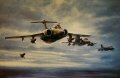  Blue -Fire! by Michael Rondot. |   Balloon Buster by Robert Taylor. |
Return to Aviation Directory Search Home
|
Everything we obtain for this site is shown on the site, we do not have any more photos, crew lists or further information on any of the ships. COPYRIGHT NOTICE. ALL IMAGES DISPLAYED ON THIS WEBSITE ARE PROTECTED BY COPYRIGHT LAW, AND ARE OWNED BY CRANSTON FINE ARTS OR THEIR RESPECTIVE OWNERS. NO REPRODUCTION OR COPYING ALLOWED ON OTHER WEBSITES, BOOKS OR ARTICLES WITHOUT PRIOR AGREEMENT. |
|
Contact Details |
|
Sign Up To Our Newsletter!
This website is owned by Cranston Fine Arts. Torwood House, Torwoodhill Road, Rhu, Helensburgh, Scotland, G848LE Contact: Tel: (+44) (0) 1436 820269. Email: cranstonorders -at- outlook.com |
 |

 Died : 2003