|
|
|
|
|
|

|
Naval History by Country :
|
|||||||||||||
| VIEW ALL OF OUR CURRENT ART SPECIAL OFFERS ON ONE PAGE HERE | |||
| NAVAL ART | AVIATION ART | MILITARY ART | SPORT ART |
|
|
Bert Winwood |
|
Name : Bert Winwood Died : 2012 |
WO A.E. 'Bert' Winwood was a Navigator on Mosquitoes and Beaufighters, flew only with pilot Ray Harrington attached to 603 sqn in the Greek Campaign. Bert did his Navigator training in Canada and in January 1944 was posted to 603 Squadron on Beaufighters, based at Gambut, near Tobruk. From here they launched attacks right across the Mediterranean into Crete, Greece and the Aegean Islands against shipping, harbour installations and enemy aircraft with much success. In December 1944 he was posted to 235 Squadron at RAF Banff flying as navigator on Mosquito's flying in the Banff Strike Wing. In April 1945 he was shot down when returning from a strike in the Kattegat, he and his pilot Ray Harrington avoided capture, and with the help of the Danish resistance made it home to England. After a short rest he continued to fly again from RAF Banff, he left the RAF in 1946.
 Bert Winwood during a signing session in March 2010. Report from the Squadron Operational Record Book from the day his Mosquito was forced to belly-land in Denmark : 5th April 1945 : The Banff Strike Wing led by W/Cdr A H Simmonds DFC was airborne between 1410-1421 hrs. It comprised 13 RP aircraft of 235 Sqdn, 11 RP of 143 Sqdn, 10 RP of 248 Sqdn also 2 fighter aircraft of 333 (Capr Wenger leading) 2 of 143 Sqdn and 1 of 235 Sqdn. The Wing made R/V over Peterhead with 12 Mustangs and S/C on a Rover patrol into the KATTEGAT. T/235 returned early with failure engineer and V/235 also returned early escorting a Mustang in distress. The Danish coast was crossed in good weather 6/10 cloud at 2,500ft with vis. 15-20mls. Near ANHOLT 3 convoys were sighted. The first consisted of 1 E/V plus 5 small M/Vs on a southerly course. The second convoy of 1 M/V of approx. 1500 tons and 2 E/Vs was on a northerly course and the third of 4 small coasters in line astern was on an easterly course. An attack was made on the first of these convoys. This comprised : (A) 1 M/V of 1200-1500 tons 3 island type. (B) 1 Small escort vessel. (C) 1 Coaster of 1000 tons. (D) 1 M/V of 1500-2000 tons, 3 island type. (E) 1 M/V of 800-1000 tons. (F) 1 M/V of 1000-1500 tons. M/V (A) was seen to be attacked by U/235. M/V (B) was attacked by 6 aircraft with RP and cannon, (C) was attacked by 4 aircraft with RP and cannon, (D) was attacked by 6 aircraft with RP and cannon, (E) was attacked by 3 aircraft with RP and cannon, and (F) by 7 aircraft with RP and cannon and wet and dry hits were observed on all ships. M/V (E) was seen to blow up and M/V (D) was burning furiously and seemed to be listing. (C) and (F) were both smoking heavily and down by the stern. (A) and (B) were both left smoking. 2 aircraft of 235 Sqn attacked the third vessel in line of the third convoy with RP and cannon. A large explosion was seen followed by flares and a column of smoke. U/235 (P/O Arthars and F/S Richardson) was seen to collide with the mast of a ship during the attack and broke up and dived into the sea. E/333 (Capt Wenger and Sgt Hansen) failed to return but the crew have since repatriated from Sweden. 1 aircraft believed F/235 (Harrington and Winwood) with a glycol leak was seen to make a belly landing in a field position 56 48N 08 21E. The last aircraft mentioned in the report is that of Bert Winwood and Ray Harrington. During signatures sessions, Bert Winwood also provided us with the photgraphs of the two men lost when their aircraft collided with the mast of a ship during the raid. Below are the photos of P/O Laurie Arthars and F/S Geg Richardson.  P/O Laurie Arthars 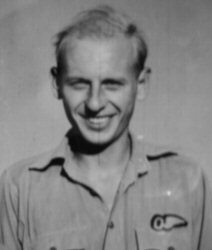 F/S Geg Richardson |
Known Service Details : | |||||||
Squadron | Rank | Start of Service | End of Service | Known Dates | Aircraft | Airframes | Notes |
January 1944 | December 1944 | ||||||
December 1944 | 5th April 1945 | ||||||
Artwork signed by this Pilot or Aircrew |
  Seastrike by Ivan Berryman. (C) |   Knockout Blow by Ivan Berryman. (P) |   The Mosquito's Sting by Ivan Berryman. (P) |
  Half-Salvo by Ivan Berryman. (P) |   Clipped Signature - Bert Winwood. |   Return From Leipzig by Anthony Saunders. (E) |
  Trainbusters by Nicolas Trudgian. (APB) |   Top Dog by Robert Taylor. (AP) |   Vital Support by Robert Taylor. |
  Trouble Brewing by Keith Aspinall. (B) |   Mosquitos by Keith Woodcock. (C) |
Known Individual Aircraft : | ||||||||
Type | Serial | Codes | First Flew | Squadron History | Aircrew History | History Notes | Engine | Factory |
LA-F | - | |||||||
| Aircraft for : Bert Winwood | ||
| A list of all aircraft associated with Bert Winwood. A profile page including a list of all art prints for the aircraft is available by clicking the aircraft name. | ||
| Aircraft | Info | |
Beaufighter 
Manufacturer : Bristol Production Began : 1940 Number Built : 5564 | Beaufighter BRISTOL BEAUFIGHTER The Bristol Beaufighter was a Torpedo Bomber and had a crew of two. with a maximum speed of 330mph and a ceiling of 29,000 feet. maximum normal range of 1500 miles but could be extended to 1750 miles. The Bristol Beaufighter carried four 20mm cannon in the belly of the aircraft and upto six .303in browning machine guns in the wings. it could also carry eight 3 -inch rockets, 1605 lb torpedo or a bomb load of 1,000 lb. The Bristol Beaufighter first flew in July 1939 and with some modifications entered service with the Royal Air Force in July 1940. In the winter of 1940 - 1941 the Beaufighter was used as a night fighter. and in March 1941 the aircraft was used at Coastal Command as a long range strike aircraft. and in 1941, the Beaufighter arrived in North Africa and used as a forward ground attack aircraft. The Bristol Beaufighter was used also in India, Burma and Australia. A total of 5,564 Beaufighters were built until production in Britain finished in 1945, but a further 364 were built in Australia for the Australian Air Force | |
Mosquito 
Manufacturer : De Havilland Production Began : 1940 Retired : 1955 Number Built : 7781 | Mosquito Used as a night fighter, fighter bomber, bomber and Photo-reconnaissance, with a crew of two, Maximum speed was 425 mph, at 30,300 feet, 380mph at 17,000ft. and a ceiling of 36,000feet, maximum range 3,500 miles. the Mosquito was armed with four 20mm Hospano cannon in belly and four .303 inch browning machine guns in nose. Coastal strike aircraft had eight 3-inch Rockets under the wings, and one 57mm shell gun in belly. The Mossie at it was known made its first flight on 25th November 1940, and the mosquito made its first operational flight for the Royal Air Force as a reconnaissance unit based at Benson. In early 1942, a modified version (mark II) operated as a night fighter with 157 and 23 squadron's. In April 1943 the first De Haviland Mosquito saw service in the Far east and in 1944 The Mosquito was used at Coastal Command in its strike wings. Bomber Commands offensive against Germany saw many Mosquitos, used as photo Reconnaissance aircraft, Fighter Escorts, and Path Finders. The Mosquito stayed in service with the Royal Air Force until 1955. and a total of 7781 mosquito's were built. | |
| Squadrons for : Bert Winwood | ||
| A list of all squadrons known to have been served with by Bert Winwood. A profile page is available by clicking the squadron name. | ||
| Squadron | Info | |
No.235 Sqn RAF Country : UK Founded : August 1918 Fate : Disbanded 10th July 1945 Jaculamur humi - We strike them to the ground | No.235 Sqn RAF Full profile not yet available. | |
No.603 Sqn RAF Country : UK Founded : 14th October 1925 Fate : Disbanded 10th March 1957 City of Edinburgh (Auxiliary) Gin ye daur - If you dare | No.603 Sqn RAF No 603 Squadron was formed on 14 October 1925 at Turnhouse as a day bomber unit of the Auxiliary Air Force. Originally equipped with DH9As and using Avro 504Ks for flying training, the squadron re-equipped with Wapitis in March 1930, these being replaced by Harts in February 1934. On 24 October 1938, No 603 was redesignated a fighter unit and flew Hinds until the arrival of Gladiators at the end of March 1939. Within two weeks of the outbreak of war in September 1939, the squadron began to receive Spitfires and passed on its Gladiators to other squadrons during October. It was operational with Spitfires in time to intercept the first German air raid on the British Isles on 16 October, when it destroyed the first enemy aircraft to be shot down over Britain in the Second World War. It remained on defensive duties in Scotland until the end of August 1940, when it moved to southern England for the remaining months of the Battle of Britain, returning to Scotland at the end of December. In May 1941, the squadron moved south again to take part in sweeps over France until the end of the year. After a further spell in Scotland, No.603 left in April 1942 for the Middle East where its ground echelon arrived early in June. The squadron's aircraft were embarked on the US carrier 'Wasp' and flown off to Malta on 20 April to reinforce the fighter defences of the beleaguered island. After nearly four months defending Malta, the remaining pilots and aircraft were absorbed by No.229 Squadron on 3 August 1942. | |
Return to Aviation Directory Search Home
|
Everything we obtain for this site is shown on the site, we do not have any more photos, crew lists or further information on any of the ships. COPYRIGHT NOTICE. ALL IMAGES DISPLAYED ON THIS WEBSITE ARE PROTECTED BY COPYRIGHT LAW, AND ARE OWNED BY CRANSTON FINE ARTS OR THEIR RESPECTIVE OWNERS. NO REPRODUCTION OR COPYING ALLOWED ON OTHER WEBSITES, BOOKS OR ARTICLES WITHOUT PRIOR AGREEMENT. |
|
Contact Details |
|
Sign Up To Our Newsletter!
This website is owned by Cranston Fine Arts. Torwood House, Torwoodhill Road, Rhu, Helensburgh, Scotland, G848LE Contact: Tel: (+44) (0) 1436 820269. Email: cranstonorders -at- outlook.com |
 |


