|
|
|
|
|
|

|
Naval History by Country :
|
|||||||||||||
| VIEW ALL OF OUR CURRENT ART SPECIAL OFFERS ON ONE PAGE HERE | |||
| NAVAL ART | AVIATION ART | MILITARY ART | SPORT ART |
|
|
No.270 Sqn RAF |
|
Name : No.270 Sqn RAF Founded : 6th April 1919 Disbanded : 30th June 1945 Country : UK Fate : Disbanded 30th June 1945 |
Known Service Details : | |||||||
Pilot or Aircrew | Rank | Start of Service | End of Service | Known Dates | Aircraft | Airframes | Notes |
Flight Lieutenant | unknown | unknown | 14th December 1942 | On December 14 1942, six men were spotted adrift on a raft 10 miles east of Dover, and Fletcher touched down in the rough seas even though he knew that it would be impossible to take off again. In failing light he made three passes, picking up the men one by one – although several of them were swept from the raft. Even as his Walrus started to take in water he succeeded in recovering one of the survivors. By now it was completely dark, and Fletcher reluctantly abandoned the search and started to taxi towards Dover. The aircraft continued to ship water, and it took him almost two hours to make the harbour – where the harbour master reprimanded him for not getting permission to bring the sinking aircraft into port. The survivors for whom Fletcher had gone to such lengths were German sailors. Fletcher was awarded an immediate Bar to his DFM, one of only 60 awarded in the Second World War. | |||
| Pilots and Aircrew for : No.270 Sqn RAF | ||
| A list of all aircrew from our database who are associated with this squadron. A profile page is available by clicking their name. | ||
| Name | Info | |
| Fletcher, Thomas Click the name above to see a profile of Fletcher, Thomas
| Fletcher, Thomas On October 2 1942 a Spitfire pilot was forced to bail out over the English Channel, landing in the sea four miles off the French coast on the edge of a minefield. When his leader transmitted an emergency call, the naval authorities at Dover decided it was impossible to get a launch through the minefield, and too dangerous for rescue by a Walrus amphibious aircraft. Despite this, Fletcher immediately volunteered to go, taking off in his Walrus with a Spitfire squadron providing an escort. He arrived on the scene just as another Spitfire squadron was engaging enemy fighters trying to interfere with the rescue. He located the dinghy, landed 150 yards away and taxied towards the survivor, who failed to grasp the boathook on the first pass as he fell out of his dinghy. In the strong wind and choppy sea Fletcher tried again, and the pilot was hauled on board. He then taxied clear of the minefield and took off, just clearing a floating mine. Throughout the operation his Walrus had come under heavy fire from shore batteries. The Air Officer Commanding of No 11 (Fighter) Group strongly recommended Fletcher for a Victoria Cross, writing: "Sergeant Fletcher was fully aware of the risks involved when he volunteered for the task. He carried out the rescue with conspicuous gallantry... he ignored all dangers, and through coolness, considered judgment and skill succeeded in picking up the pilot." In the event, Fletcher was awarded an immediate DFM, the next highest gallantry award available for a SNCO at that time. Thomas Fletcher was born on September 7 1914 at Leigh in Lancashire and educated at Leigh Grammar School. Although his job as a commercial traveller for a medical equipment business was, at the beginning of the war, classified as a reserved occupation, he volunteered to be a pilot in the RAF, joining up in June 1940. On completing his training, he joined No 43 Squadron to fly Spitfires as a sergeant pilot. An effervescent, outspoken and sometimes rebellious character, Fletcher did not see eye-to-eye with his CO, who had him transferred to another Spitfire squadron flying coastal patrols. This fitted him well for air-sea rescue duties, and he joined a flight at Hawkinge, which soon became No 277 Squadron. Flying a Lysander spotting aircraft during the summer of 1942, Fletcher found a number of aircrew in the sea and directed RAF high speed launches to rescue them. By the time of his exploit in the minefield in October he had already helped to save nine airmen. On December 14 1942, six men were spotted adrift on a raft 10 miles east of Dover, and Fletcher touched down in the rough seas even though he knew that it would be impossible to take off again. In failing light he made three passes, picking up the men one by one – although several of them were swept from the raft. Even as his Walrus started to take in water he succeeded in recovering one of the survivors. By now it was completely dark, and Fletcher reluctantly abandoned the search and started to taxi towards Dover. The aircraft continued to ship water, and it took him almost two hours to make the harbour – where the harbour master reprimanded him for not getting permission to bring the sinking aircraft into port. The survivors for whom Fletcher had gone to such lengths were German sailors. Fletcher was awarded an immediate Bar to his DFM, one of only 60 awarded in the Second World War. In the summer of 1943 Fletcher picked up seven more ditched aircrew, including a USAAF fighter pilot and a Belgian Spitfire pilot. Then, on October 3, he went in search of a Typhoon pilot reported in the sea too near the French coast for a launch to attempt a rescue. Fletcher found three dinghies, landed and picked up the occupants – survivors from an RAF bomber. Having taken them back to base, he immediately took off again, finally locating and rescuing the Typhoon pilot. The sea was too rough for a take-off, and he began the long taxi back to England. A Royal Navy launch was sent to assist, but then the Walrus lost a float. The attempt to tow the aircraft failed, and it started to sink. Fletcher, his crew and their survivor had to abandon the Walrus and transfer to the launch. He was awarded an immediate DFC. In spring the next year Fletcher took off to rescue a Canadian fighter pilot. The dinghy was so close to the French coast that he had to fly over enemy-held territory to approach it, so that he would be in a position for an immediate take-off. Throughout the rescue he was under heavy anti-aircraft fire and his crewman was wounded. The pilot was snatched from the sea as Fletcher taxied past and brought back to England. Fletcher later rescued an American bomber crew from the Somme Estuary and, on April 30, a Spitfire pilot – his final rescue. He had by now saved more people than any other pilot. Remaining in the RAF after the war, in July 1945 Fletcher was attached to the High Speed Flight as the search-and-rescue pilot when Group Captain EM Donaldson broke the world speed record off the Sussex coast flying a Meteor jet. He later served as an instructor at the Search and Rescue Training Unit. In 1948 he was badly burned when his Mosquito crashed during a training sortie at the Central Flying School. Fletcher trained as a fighter controller, but returned to flying in 1956 before continuing his career at ground control centres in Fighter Command. He retired from the RAF in 1964. | |
| Hillier, Sydney Click the name above to see a profile of Hillier, Sydney | Hillier, Sydney Sydney Hiller was a member of the crew of Catalina D for Donald of 270 Squadron. The squadron was based for most of the war at Freetown, West Africa. He was a member of the crew when his aircraft launched a surprise attack on u-boat U-515. | |
| Morrison, Alex Click the name above to see a profile of Morrison, Alex | Morrison, Alex Alex Morrison was a member of the crew of Catalina D for Donald of 270 Squadron. The squadron was based for most of the war at Freetown, West Africa. He was a member of the crew when his aircraft launched a surprise attack on u-boat U-515. | |
| Aircraft for : No.270 Sqn RAF | ||
| A list of all aircraft associated with No.270 Sqn RAF. A profile page including a list of all art prints for the aircraft is available by clicking the aircraft name. | ||
| Aircraft | Info | |
Catalina 
Manufacturer : Consolidated Production Began : 1936 Retired : 1957 Number Built : 3305 | Catalina Built by the Consolidated Aircraft Company and designed by Isaax M Ladden. the Catalina first flew on the 28th march 1935. and first flew with the US Navy in October 1936. In 1935 the cost of each Catalina was $90,000 and just over 4,000 were built. The Catalina was used in various maritime roles. but it was designed initially as a maritime patrol bomber. Its long range was intended to seek out enemy transport and supply ships. but was eventually used in many roles including Convoy escort,, anti submarine warfare and search and rescue. In its role as a search and rescue aircraft it probably is best remembered for many thousands of aircrews shot down in the Pacific and less extend in the Atlantic and Mediterranean. The Catalina was the most successful flying boat of the war and even served in a military role until the early 1980's some are still used today in aerial firefighting. | |
Walrus 
| Walrus Full profile not yet available. | |
No.270 Sqn RAF Artwork |
 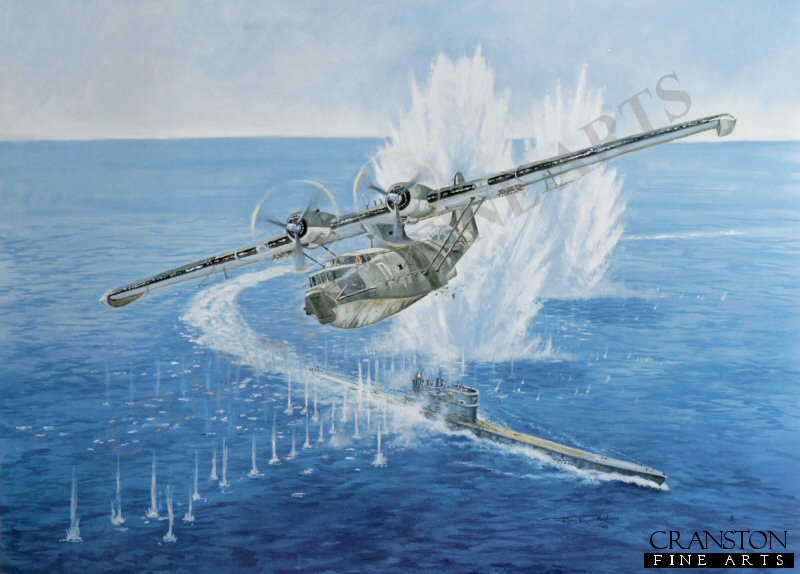 Catalina Attack by John Wynne Hopkins. |
Return to Aviation Directory Search Home
|
Everything we obtain for this site is shown on the site, we do not have any more photos, crew lists or further information on any of the ships. COPYRIGHT NOTICE. ALL IMAGES DISPLAYED ON THIS WEBSITE ARE PROTECTED BY COPYRIGHT LAW, AND ARE OWNED BY CRANSTON FINE ARTS OR THEIR RESPECTIVE OWNERS. NO REPRODUCTION OR COPYING ALLOWED ON OTHER WEBSITES, BOOKS OR ARTICLES WITHOUT PRIOR AGREEMENT. |
|
Contact Details |
|
Sign Up To Our Newsletter!
This website is owned by Cranston Fine Arts. Torwood House, Torwoodhill Road, Rhu, Helensburgh, Scotland, G848LE Contact: Tel: (+44) (0) 1436 820269. Email: cranstonorders -at- outlook.com |
 |

 Died : 10 / 3 / 2010