|
|
|
|
|
|

|
Naval History by Country :
|
|||||||||||||
| VIEW ALL OF OUR CURRENT ART SPECIAL OFFERS ON ONE PAGE HERE | |||
| NAVAL ART | AVIATION ART | MILITARY ART | SPORT ART |
|
HMS Highflyer |
| Name :
HMS Highflyer Laid Down : June 1897 Launched : 4th June 1898 Completed : 7th December 1899 Type : Cruiser Class : Hermes Builder : Fairfield Country : UK Sequence : This is the 4th ship with this name. Pennants : Fate : Sold for scrap 10th June 1921 |
| Highflyer was laid down by Fairfield Shipbuilding & Engineering at their shipyard in Govan, Scotland on 7 June 1897 and launched on 4 June 1898. She was completed on 7 December 1899 and commissioned by Captain Frederic Brock for the Training squadron. In February 1900 she was re-commissioned to serve in the Indian Ocean as the flagship of Rear-Admiral Day Bosanquet, Commander-in-Chief, East Indies Station. Captain Arthur Christian was appointed in command of the ship on in June 1902, as Flag captain to Rear-Admiral Charles Carter Drury, who succeeded Bosanquet as Commander-in-Chief of the Station. She was transferred to the North America and West Indies Station in 1904 and served as its flagship until November 1906 when returned to the East Indies Station. Highflyer was placed in reserve at Devonport Royal Dockyard in 1908 and then assigned to the reserve Third Fleet in 1910. She was again assigned as the flagship of the East Indies Station in February 1911 until departing for home in April 1913. In August 1913 she became the training ship for Special Entry Cadets. In August 1914 she was allocated to the 9th Cruiser Squadron, under Rear Admiral John de Robeck, on the Finisterre station. She left Plymouth on 4 August, in the company of the admiral on HMS Vindictive. The Dutch ocean liner Tubantia, was returning from South America when the war began with £500,000 in gold destined for banks in London, a large portion of which was intended for the German Bank of London. She was also carrying about 150 German reservists in steerage and a cargo of grain destined for Germany. She was stopped and boarded by an officer and crewmen from Highflyer, and escorted into port at Plymouth. She was then transferred to the Cape Verde station, to support Rear Admiral Archibald Stoddart’s 5th Cruiser Squadron in the hunt for the German armed merchant cruiser SS Kaiser Wilhelm der Grosse. She had been sighted at Río de Oro, a Spanish anchorage on the Saharan coast. On 26 August Highflyer found the German ship taking on coal from three colliers. Highflyer's captain demanded that the Germans surrender. The captain of the Kaiser Wilhelm der Grosse claimed the protection of neutral waters, but as he was breaking that neutrality himself by staying for more than a week, his claim was denied. Fighting broke out at 15:10, and lasted until 16:45, when the crew of the Kaiser Wilhelm der Grosse abandoned ship and escaped to the shore. The German ship was sunk, with the British losing one man killed (Richard James Lobb) and five injured in the engagement. In mid-1916 the Prize Court awarded the crew of Highflyer ₤2,680 for the sinking of the German ship. On 15 October Highflyer briefly became the flagship of the Cape Verde station, when Stoddard was ordered to Pernambuco, Brazil. Later in the same month she was ordered to accompany the transport ships carrying the Cape garrison back to Britain and then searched the Atlantic coast of North Africa for the German light cruiser SMS Karlsruhe. After the Battle of Coronel in November, Highflyer came back under the control of Admiral de Robeck, as part of a squadron formed to guard West Africa against Admiral Maximilian von Spee. This squadron, consisting of the cruisers HMS Warrior, HMS Black Prince, HMS Donegal and Highflyer was in place off Sierra Leone from 12 November, but was soon dispersed after the battle of the Falklands in December. Highflyer then took part in the search for the commerce raider Kronprinz Wilhelm, coming close to catching her in January 1915. She remained on the West Africa station until she was transferred to the North America and West Indies Squadron in 1917. This was the period of unrestricted submarine warfare, and the Admiralty eventually decided to operate a convoy system in the North Atlantic. On 10 July 1917 Highflyer provided the escort for convoy HS 1, the first convoy to sail from Canada to Britain. She was in Halifax for the Halifax Explosion on 6 December 1917 On the morning of 6 Dec 1917 anchored in the outer harbour Halifax harbour, Nova Scotia, Canada was HMS "Highflyer", a Hermes class cruiser carrying out escort duties. Steaming out of the inner harbour was the Norwegian ship SS IMO heading for New York. Coming from New York was the SS Mont Blanc loaded with explosives and volatile benzol stacked on her decks. Both ships collided in the "narrows". Benzol drums broke loose and caught fire. All hands were ordered to abandon ship and the Mont Blanc drifted ablaze until she came to rest against pier 6 in the harbour. At around 9.05 am the Mont Blanc exploded. This explosion killed over sixteen hundred people and flattened two square kilometres of Halifax. Amongst those killed was Claude Eggleton Rushen and six of his ship mates from HMS Highflyer. The Albert Medal in Gold was awarded to Lt. Cmdr. Triggs for life saving at sea. He was in charge of a whaler from HMS Highflyer, manned by volunteers, that rowed towards the pier and the burning Mont Blanc to see if the Imo might be towed clear of danger. When only 100 yards away the Mont Blanc blew up. Lt. Cmdr. Triggs and all but one of the crew were lost. Claude Eggleton Rushen was one of the crew. . Many aboard the ship were injured by blast and she was lightly damaged herself. Her crew provided medical care to survivors and helped to clear debris. She departed Halifax on 11 December to escort a convoy to Plymouth. Highflyer returned to the East Indies Station in 1918 and was paid off at Bombay in March 1919. She was recommissioned in July as the station flagship and served until she was paid off in early 1921 and sold for scrap there on 10 June |
HMS Highflyer Photos for Sale |
  HMS Highflyer, 1900. |   HMS Highflyer, 1900. | 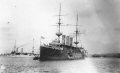  HMS Highflyer, 1905. |   HMS Highflyer, 1916. | 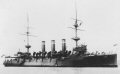  HMS Highflyer, 1913. |
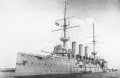  HMS Highflyer. Photo published 1915. |   HMS Highflyer. | 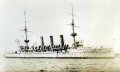  HMS Highflyer. |  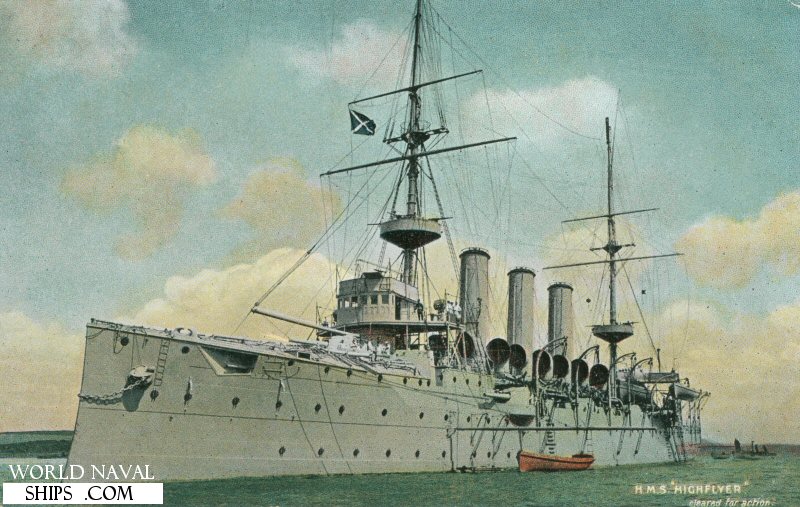 HMS Highflyer. |
|||||||||||||||||||||||||||
Known Crew Details : | |||
Name | Start of Service | End of Service | Known Date |
25th November 1906 | 10th September 1908 | 0th 0 | |
Timeline Entries : | |||
4th June 1898 - Launched 1900 - Training Squadron 1901 - East Indies Station 1902 - East Indies Station 1903 - East Indies Station 1905 - North America and West Indies Station 1906 - 4th Cruiser Squadron, North America and West Indies June 1906 - North America & West Indies. 4th Cruiser Squadron 1908 - East Indies Station April 1909 - 3rd Division, Home Fleet at Plymouth 19th March 1911 - Capt A.R. Hulbert in Command 19th March 1911 - Arrived Aden 21st March 1911 - Sailed Aden 1917 - Based in the West Indies to 1918 1st June 1919 - 4th Light Cruiser Squadron East Indies Station 1st November 1919 - Arrived Aden 4th November 1919 - Arrived Berbera en route to Colommbo 6th December 1919 - Sailed Colombo for Bombay 25th June 1920 - Arrived Dar-es-Salaam 25th June 1920 - Sailed Zanzibar 29th January 1921 - Arrived Bombay June 1921 - Sold for scrapping | |||
HMS Highflyer Artwork Collection |
 A Boat Setting Out From HMS Highflyer with Surgical And Medical Aid For The Enemys Wounded |
Database Currently Holds : 6284 ships and 6289 crew!
Last edited : 23:27, January 15, 2017
By : HMS
|
Everything we obtain for this site is shown on the site, we do not have any more photos, crew lists or further information on any of the ships. COPYRIGHT NOTICE. ALL IMAGES DISPLAYED ON THIS WEBSITE ARE PROTECTED BY COPYRIGHT LAW, AND ARE OWNED BY CRANSTON FINE ARTS OR THEIR RESPECTIVE OWNERS. NO REPRODUCTION OR COPYING ALLOWED ON OTHER WEBSITES, BOOKS OR ARTICLES WITHOUT PRIOR AGREEMENT. |
|
Contact Details |
|
Sign Up To Our Newsletter!
This website is owned by Cranston Fine Arts. Torwood House, Torwoodhill Road, Rhu, Helensburgh, Scotland, G848LE Contact: Tel: (+44) (0) 1436 820269. Email: cranstonorders -at- outlook.com |
 |

