|
|
|
|
|
|

|
Naval History by Country :
|
|||||||||||||
| VIEW ALL OF OUR CURRENT ART SPECIAL OFFERS ON ONE PAGE HERE | |||
| NAVAL ART | AVIATION ART | MILITARY ART | SPORT ART |
|
|
Halifax LK789 |
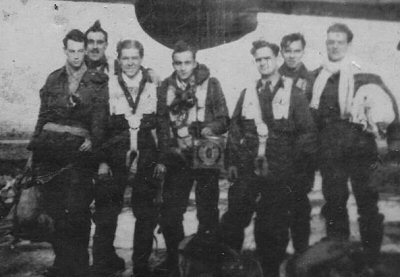 Crew of Halifax LK789. Type : Halifax Mark : III Known Codes : MP-L |
| Known information | |
| 25th April 1944 | Shot down over Norfolk by Me410 nightfighter intruder of Lt Wolfgang Wenning. Five of the six crew were killed. |
| Pilots and Aircrew who flew : Halifax III LK789 | ||
| A list of all aircrew from our database who are associated with this aircraft. A profile page is available by clicking their name. | ||
| Name | Info | |
| Anderson, John Click the name above to see a profile of Anderson, John | Anderson, John Halifax Air Gunner. Killed after his Halifax was shot down by an Me.410. Notes on research by Mike Harrison follows : Took off from Holme-on-Spalding Moor at 22.09 hrs to attack Karlsruhe. 637 aircraft took part in the raid made up from 369 Lancasters, 259 Halifax and 9 Mosquitoes. A total of 19 aircraft, 11 Lancasters, 8 Halifax were lost (1 from 76 Squadron) 3% of the force. According to reports, cloud over the target and a strong wind which pushed the Pathfinders too far north, spoiled this attack. The markers appeared to be very scattered, consequently the bombing was not concentrated, however many large fires were seen reflected through the cloud and several explosions were also observed. Enemy fighter activity was also handicapped owing to the 10/10th cloud, and the ground defences were ineffective. Only the northern part of Karlsruhe was seriously damaged and most of the bombs fell outside the city. Later as the main force recrossed the English coast, enemy intruder aircraft were patrolling over Eastern England. Halifax LK789 was attacked by a Me410 flown by Leutnant Wolfgang Wenning of II./KG51 at a height of 1,000 mtrs, 20km NE of Cambridge. During the attack, another 76 Squadron Halifax, LK785 T-Topsy piloted by Lieutenant Carl Larsen R.N.A.F was flying on the right hand side of the bomber. The following eye witness account is by Sgt H.W Kirtland the wireless operator onboard T-Topsy : We were within an hour from base and safety and had no idea intruders were operating. As usual, when routed up England from the south coast, the risk of collision was our main concern, hence the Nav lights were on. From my position on the port side of the aircraft and immediately below the pilot, I had a small window which gave restricted view forward and downward on the port side. Alerted by the Skipper's shout, I looked out and saw the Halifax curving down on fire until it hit the ground. Almost certainly it had been attacked by a night fighter with an upward firing 20mm cannon. He would have stalked the Halifax from below - our blind spot aimed to strike between the bomber's fuselage and inner engines. We didn't see any parachutes, which we always looked for if the gunners reported a bomber in flames. I well remember how angry Larsen was over this we all were - it could easily been us. To be told by the Squadron Intelligence officer that there was no intruder activity that night was too much Halifax LK789 crashed opposite Colony farm near Welney, Norfolk at 04.20 hrs. The only survivor was the rear gunner, Fl/Sgt John Anderson. He was rescued by the Welney fire brigade after being trapped in his turret and taken to R.A.F. Hospital Ely, with a fractured femur and lacerations of the scalp. After recovering he visited the local fire crew to thank them and Mr Goodger, the senior member. All those killed were taken to their home towns for burial. The names of the crew are listed on the memorial in York Minster. This takes the form of The Astronomical clock, in the North transept. Below the clock face is a glass topped case with a book of remembrance listing all the names of some18,000 allied airmen who died operating from Yorkshire and the North East between 1939 and 1945. A page is turned every day of the year. Lt. Wolfgang Wenning and Fw. Gustav Delp lost their lives two days later on the 27th of April 1944 during another intruder operation over England. Their Me410 collided with an Airspeed Oxford LX196 piloted by F/O. Gregor Stephen Moore R.C.A.F whilst in circuit of Church Lawford airfield. Both aircraft crashed near Frankton, Rugby, all onboard were killed. Investigation of Halifax LK789 crash site by Jeff Carless, East Anglian Aircraft Research Group. We did make some enquiries regarding the crash of the Halifax when researching in the Welney area, we found a couple of people that knew of it. One was in bed at his house on the drove opposite to Colony Farm and was woken by cannon shells falling on the roof. He recalled that the aircraft crashed in the field opposite Colony Farm. It was described as having crashed flat rather than diving into the ground. Two of the engines were in that field and the other two ended up further down the drove. Both he and the other witness recalled that one of the crew survived the crash. | |
| Bathe, John Raymond Click the name above to see a profile of Bathe, John Raymond
| Bathe, John Raymond Halifax Bomb Aimer. Killed after his Halifax was shot down by an Me.410. Notes on research by Mike Harrison follows : Took off from Holme-on-Spalding Moor at 22.09 hrs to attack Karlsruhe. 637 aircraft took part in the raid made up from 369 Lancasters, 259 Halifax and 9 Mosquitoes. A total of 19 aircraft, 11 Lancasters, 8 Halifax were lost (1 from 76 Squadron) 3% of the force. According to reports, cloud over the target and a strong wind which pushed the Pathfinders too far north, spoiled this attack. The markers appeared to be very scattered, consequently the bombing was not concentrated, however many large fires were seen reflected through the cloud and several explosions were also observed. Enemy fighter activity was also handicapped owing to the 10/10th cloud, and the ground defences were ineffective. Only the northern part of Karlsruhe was seriously damaged and most of the bombs fell outside the city. Later as the main force recrossed the English coast, enemy intruder aircraft were patrolling over Eastern England. Halifax LK789 was attacked by a Me410 flown by Leutnant Wolfgang Wenning of II./KG51 at a height of 1,000 mtrs, 20km NE of Cambridge. During the attack, another 76 Squadron Halifax, LK785 T-Topsy piloted by Lieutenant Carl Larsen R.N.A.F was flying on the right hand side of the bomber. The following eye witness account is by Sgt H.W Kirtland the wireless operator onboard T-Topsy : We were within an hour from base and safety and had no idea intruders were operating. As usual, when routed up England from the south coast, the risk of collision was our main concern, hence the Nav lights were on. From my position on the port side of the aircraft and immediately below the pilot, I had a small window which gave restricted view forward and downward on the port side. Alerted by the Skipper's shout, I looked out and saw the Halifax curving down on fire until it hit the ground. Almost certainly it had been attacked by a night fighter with an upward firing 20mm cannon. He would have stalked the Halifax from below - our blind spot aimed to strike between the bomber's fuselage and inner engines. We didn't see any parachutes, which we always looked for if the gunners reported a bomber in flames. I well remember how angry Larsen was over this we all were - it could easily been us. To be told by the Squadron Intelligence officer that there was no intruder activity that night was too much Halifax LK789 crashed opposite Colony farm near Welney, Norfolk at 04.20 hrs. The only survivor was the rear gunner, Fl/Sgt John Anderson. He was rescued by the Welney fire brigade after being trapped in his turret and taken to R.A.F. Hospital Ely, with a fractured femur and lacerations of the scalp. After recovering he visited the local fire crew to thank them and Mr Goodger, the senior member. All those killed were taken to their home towns for burial. The names of the crew are listed on the memorial in York Minster. This takes the form of The Astronomical clock, in the North transept. Below the clock face is a glass topped case with a book of remembrance listing all the names of some18,000 allied airmen who died operating from Yorkshire and the North East between 1939 and 1945. A page is turned every day of the year. Lt. Wolfgang Wenning and Fw. Gustav Delp lost their lives two days later on the 27th of April 1944 during another intruder operation over England. Their Me410 collided with an Airspeed Oxford LX196 piloted by F/O. Gregor Stephen Moore R.C.A.F whilst in circuit of Church Lawford airfield. Both aircraft crashed near Frankton, Rugby, all onboard were killed. Investigation of Halifax LK789 crash site by Jeff Carless, East Anglian Aircraft Research Group. We did make some enquiries regarding the crash of the Halifax when researching in the Welney area, we found a couple of people that knew of it. One was in bed at his house on the drove opposite to Colony Farm and was woken by cannon shells falling on the roof. He recalled that the aircraft crashed in the field opposite Colony Farm. It was described as having crashed flat rather than diving into the ground. Two of the engines were in that field and the other two ended up further down the drove. Both he and the other witness recalled that one of the crew survived the crash. | |
| Davenport, James George Click the name above to see a profile of Davenport, James George
| Davenport, James George Halifax Wireless Operator. Killed after his Halifax was shot down by an Me.410. Notes on research by Mike Harrison follows : Took off from Holme-on-Spalding Moor at 22.09 hrs to attack Karlsruhe. 637 aircraft took part in the raid made up from 369 Lancasters, 259 Halifax and 9 Mosquitoes. A total of 19 aircraft, 11 Lancasters, 8 Halifax were lost (1 from 76 Squadron) 3% of the force. According to reports, cloud over the target and a strong wind which pushed the Pathfinders too far north, spoiled this attack. The markers appeared to be very scattered, consequently the bombing was not concentrated, however many large fires were seen reflected through the cloud and several explosions were also observed. Enemy fighter activity was also handicapped owing to the 10/10th cloud, and the ground defences were ineffective. Only the northern part of Karlsruhe was seriously damaged and most of the bombs fell outside the city. Later as the main force recrossed the English coast, enemy intruder aircraft were patrolling over Eastern England. Halifax LK789 was attacked by a Me410 flown by Leutnant Wolfgang Wenning of II./KG51 at a height of 1,000 mtrs, 20km NE of Cambridge. During the attack, another 76 Squadron Halifax, LK785 T-Topsy piloted by Lieutenant Carl Larsen R.N.A.F was flying on the right hand side of the bomber. The following eye witness account is by Sgt H.W Kirtland the wireless operator onboard T-Topsy : We were within an hour from base and safety and had no idea intruders were operating. As usual, when routed up England from the south coast, the risk of collision was our main concern, hence the Nav lights were on. From my position on the port side of the aircraft and immediately below the pilot, I had a small window which gave restricted view forward and downward on the port side. Alerted by the Skipper's shout, I looked out and saw the Halifax curving down on fire until it hit the ground. Almost certainly it had been attacked by a night fighter with an upward firing 20mm cannon. He would have stalked the Halifax from below - our blind spot aimed to strike between the bomber's fuselage and inner engines. We didn't see any parachutes, which we always looked for if the gunners reported a bomber in flames. I well remember how angry Larsen was over this we all were - it could easily been us. To be told by the Squadron Intelligence officer that there was no intruder activity that night was too much Halifax LK789 crashed opposite Colony farm near Welney, Norfolk at 04.20 hrs. The only survivor was the rear gunner, Fl/Sgt John Anderson. He was rescued by the Welney fire brigade after being trapped in his turret and taken to R.A.F. Hospital Ely, with a fractured femur and lacerations of the scalp. After recovering he visited the local fire crew to thank them and Mr Goodger, the senior member. All those killed were taken to their home towns for burial. The names of the crew are listed on the memorial in York Minster. This takes the form of The Astronomical clock, in the North transept. Below the clock face is a glass topped case with a book of remembrance listing all the names of some18,000 allied airmen who died operating from Yorkshire and the North East between 1939 and 1945. A page is turned every day of the year. Lt. Wolfgang Wenning and Fw. Gustav Delp lost their lives two days later on the 27th of April 1944 during another intruder operation over England. Their Me410 collided with an Airspeed Oxford LX196 piloted by F/O. Gregor Stephen Moore R.C.A.F whilst in circuit of Church Lawford airfield. Both aircraft crashed near Frankton, Rugby, all onboard were killed. Investigation of Halifax LK789 crash site by Jeff Carless, East Anglian Aircraft Research Group. We did make some enquiries regarding the crash of the Halifax when researching in the Welney area, we found a couple of people that knew of it. One was in bed at his house on the drove opposite to Colony Farm and was woken by cannon shells falling on the roof. He recalled that the aircraft crashed in the field opposite Colony Farm. It was described as having crashed flat rather than diving into the ground. Two of the engines were in that field and the other two ended up further down the drove. Both he and the other witness recalled that one of the crew survived the crash. | |
| Dibbins, Douglas Robert Click the name above to see a profile of Dibbins, Douglas Robert
| Dibbins, Douglas Robert Halifax pilot. Killed after his Halifax was shot down by an Me.410. Notes on research by Mike Harrison follows : Took off from Holme-on-Spalding Moor at 22.09 hrs to attack Karlsruhe. 637 aircraft took part in the raid made up from 369 Lancasters, 259 Halifax and 9 Mosquitoes. A total of 19 aircraft, 11 Lancasters, 8 Halifax were lost (1 from 76 Squadron) 3% of the force. According to reports, cloud over the target and a strong wind which pushed the Pathfinders too far north, spoiled this attack. The markers appeared to be very scattered, consequently the bombing was not concentrated, however many large fires were seen reflected through the cloud and several explosions were also observed. Enemy fighter activity was also handicapped owing to the 10/10th cloud, and the ground defences were ineffective. Only the northern part of Karlsruhe was seriously damaged and most of the bombs fell outside the city. Later as the main force recrossed the English coast, enemy intruder aircraft were patrolling over Eastern England. Halifax LK789 was attacked by a Me410 flown by Leutnant Wolfgang Wenning of II./KG51 at a height of 1,000 mtrs, 20km NE of Cambridge. During the attack, another 76 Squadron Halifax, LK785 T-Topsy piloted by Lieutenant Carl Larsen R.N.A.F was flying on the right hand side of the bomber. The following eye witness account is by Sgt H.W Kirtland the wireless operator onboard T-Topsy : We were within an hour from base and safety and had no idea intruders were operating. As usual, when routed up England from the south coast, the risk of collision was our main concern, hence the Nav lights were on. From my position on the port side of the aircraft and immediately below the pilot, I had a small window which gave restricted view forward and downward on the port side. Alerted by the Skipper's shout, I looked out and saw the Halifax curving down on fire until it hit the ground. Almost certainly it had been attacked by a night fighter with an upward firing 20mm cannon. He would have stalked the Halifax from below - our blind spot aimed to strike between the bomber's fuselage and inner engines. We didn't see any parachutes, which we always looked for if the gunners reported a bomber in flames. I well remember how angry Larsen was over this we all were - it could easily been us. To be told by the Squadron Intelligence officer that there was no intruder activity that night was too much Halifax LK789 crashed opposite Colony farm near Welney, Norfolk at 04.20 hrs. The only survivor was the rear gunner, Fl/Sgt John Anderson. He was rescued by the Welney fire brigade after being trapped in his turret and taken to R.A.F. Hospital Ely, with a fractured femur and lacerations of the scalp. After recovering he visited the local fire crew to thank them and Mr Goodger, the senior member. All those killed were taken to their home towns for burial. The names of the crew are listed on the memorial in York Minster. This takes the form of The Astronomical clock, in the North transept. Below the clock face is a glass topped case with a book of remembrance listing all the names of some18,000 allied airmen who died operating from Yorkshire and the North East between 1939 and 1945. A page is turned every day of the year. Lt. Wolfgang Wenning and Fw. Gustav Delp lost their lives two days later on the 27th of April 1944 during another intruder operation over England. Their Me410 collided with an Airspeed Oxford LX196 piloted by F/O. Gregor Stephen Moore R.C.A.F whilst in circuit of Church Lawford airfield. Both aircraft crashed near Frankton, Rugby, all onboard were killed. Investigation of Halifax LK789 crash site by Jeff Carless, East Anglian Aircraft Research Group. We did make some enquiries regarding the crash of the Halifax when researching in the Welney area, we found a couple of people that knew of it. One was in bed at his house on the drove opposite to Colony Farm and was woken by cannon shells falling on the roof. He recalled that the aircraft crashed in the field opposite Colony Farm. It was described as having crashed flat rather than diving into the ground. Two of the engines were in that field and the other two ended up further down the drove. Both he and the other witness recalled that one of the crew survived the crash. | |
| Harrison, Norris Mervyn Click the name above to see a profile of Harrison, Norris Mervyn
| Harrison, Norris Mervyn Halifax Air Gunner. Killed after his Halifax was shot down by an Me.410. Notes on research by Mike Harrison follows : Took off from Holme-on-Spalding Moor at 22.09 hrs to attack Karlsruhe. 637 aircraft took part in the raid made up from 369 Lancasters, 259 Halifax and 9 Mosquitoes. A total of 19 aircraft, 11 Lancasters, 8 Halifax were lost (1 from 76 Squadron) 3% of the force. According to reports, cloud over the target and a strong wind which pushed the Pathfinders too far north, spoiled this attack. The markers appeared to be very scattered, consequently the bombing was not concentrated, however many large fires were seen reflected through the cloud and several explosions were also observed. Enemy fighter activity was also handicapped owing to the 10/10th cloud, and the ground defences were ineffective. Only the northern part of Karlsruhe was seriously damaged and most of the bombs fell outside the city. Later as the main force recrossed the English coast, enemy intruder aircraft were patrolling over Eastern England. Halifax LK789 was attacked by a Me410 flown by Leutnant Wolfgang Wenning of II./KG51 at a height of 1,000 mtrs, 20km NE of Cambridge. During the attack, another 76 Squadron Halifax, LK785 T-Topsy piloted by Lieutenant Carl Larsen R.N.A.F was flying on the right hand side of the bomber. The following eye witness account is by Sgt H.W Kirtland the wireless operator onboard T-Topsy : We were within an hour from base and safety and had no idea intruders were operating. As usual, when routed up England from the south coast, the risk of collision was our main concern, hence the Nav lights were on. From my position on the port side of the aircraft and immediately below the pilot, I had a small window which gave restricted view forward and downward on the port side. Alerted by the Skipper's shout, I looked out and saw the Halifax curving down on fire until it hit the ground. Almost certainly it had been attacked by a night fighter with an upward firing 20mm cannon. He would have stalked the Halifax from below - our blind spot aimed to strike between the bomber's fuselage and inner engines. We didn't see any parachutes, which we always looked for if the gunners reported a bomber in flames. I well remember how angry Larsen was over this we all were - it could easily been us. To be told by the Squadron Intelligence officer that there was no intruder activity that night was too much Halifax LK789 crashed opposite Colony farm near Welney, Norfolk at 04.20 hrs. The only survivor was the rear gunner, Fl/Sgt John Anderson. He was rescued by the Welney fire brigade after being trapped in his turret and taken to R.A.F. Hospital Ely, with a fractured femur and lacerations of the scalp. After recovering he visited the local fire crew to thank them and Mr Goodger, the senior member. All those killed were taken to their home towns for burial. The names of the crew are listed on the memorial in York Minster. This takes the form of The Astronomical clock, in the North transept. Below the clock face is a glass topped case with a book of remembrance listing all the names of some18,000 allied airmen who died operating from Yorkshire and the North East between 1939 and 1945. A page is turned every day of the year. Lt. Wolfgang Wenning and Fw. Gustav Delp lost their lives two days later on the 27th of April 1944 during another intruder operation over England. Their Me410 collided with an Airspeed Oxford LX196 piloted by F/O. Gregor Stephen Moore R.C.A.F whilst in circuit of Church Lawford airfield. Both aircraft crashed near Frankton, Rugby, all onboard were killed. Investigation of Halifax LK789 crash site by Jeff Carless, East Anglian Aircraft Research Group. We did make some enquiries regarding the crash of the Halifax when researching in the Welney area, we found a couple of people that knew of it. One was in bed at his house on the drove opposite to Colony Farm and was woken by cannon shells falling on the roof. He recalled that the aircraft crashed in the field opposite Colony Farm. It was described as having crashed flat rather than diving into the ground. Two of the engines were in that field and the other two ended up further down the drove. Both he and the other witness recalled that one of the crew survived the crash. | |
| Head, Gerard John Click the name above to see a profile of Head, Gerard John
| Head, Gerard John Halifax Flight Engineer. Killed after his Halifax was shot down by an Me.410. Notes on research by Mike Harrison follows : Took off from Holme-on-Spalding Moor at 22.09 hrs to attack Karlsruhe. 637 aircraft took part in the raid made up from 369 Lancasters, 259 Halifax and 9 Mosquitoes. A total of 19 aircraft, 11 Lancasters, 8 Halifax were lost (1 from 76 Squadron) 3% of the force. According to reports, cloud over the target and a strong wind which pushed the Pathfinders too far north, spoiled this attack. The markers appeared to be very scattered, consequently the bombing was not concentrated, however many large fires were seen reflected through the cloud and several explosions were also observed. Enemy fighter activity was also handicapped owing to the 10/10th cloud, and the ground defences were ineffective. Only the northern part of Karlsruhe was seriously damaged and most of the bombs fell outside the city. Later as the main force recrossed the English coast, enemy intruder aircraft were patrolling over Eastern England. Halifax LK789 was attacked by a Me410 flown by Leutnant Wolfgang Wenning of II./KG51 at a height of 1,000 mtrs, 20km NE of Cambridge. During the attack, another 76 Squadron Halifax, LK785 T-Topsy piloted by Lieutenant Carl Larsen R.N.A.F was flying on the right hand side of the bomber. The following eye witness account is by Sgt H.W Kirtland the wireless operator onboard T-Topsy : We were within an hour from base and safety and had no idea intruders were operating. As usual, when routed up England from the south coast, the risk of collision was our main concern, hence the Nav lights were on. From my position on the port side of the aircraft and immediately below the pilot, I had a small window which gave restricted view forward and downward on the port side. Alerted by the Skipper's shout, I looked out and saw the Halifax curving down on fire until it hit the ground. Almost certainly it had been attacked by a night fighter with an upward firing 20mm cannon. He would have stalked the Halifax from below - our blind spot aimed to strike between the bomber's fuselage and inner engines. We didn't see any parachutes, which we always looked for if the gunners reported a bomber in flames. I well remember how angry Larsen was over this we all were - it could easily been us. To be told by the Squadron Intelligence officer that there was no intruder activity that night was too much Halifax LK789 crashed opposite Colony farm near Welney, Norfolk at 04.20 hrs. The only survivor was the rear gunner, Fl/Sgt John Anderson. He was rescued by the Welney fire brigade after being trapped in his turret and taken to R.A.F. Hospital Ely, with a fractured femur and lacerations of the scalp. After recovering he visited the local fire crew to thank them and Mr Goodger, the senior member. All those killed were taken to their home towns for burial. The names of the crew are listed on the memorial in York Minster. This takes the form of The Astronomical clock, in the North transept. Below the clock face is a glass topped case with a book of remembrance listing all the names of some18,000 allied airmen who died operating from Yorkshire and the North East between 1939 and 1945. A page is turned every day of the year. Lt. Wolfgang Wenning and Fw. Gustav Delp lost their lives two days later on the 27th of April 1944 during another intruder operation over England. Their Me410 collided with an Airspeed Oxford LX196 piloted by F/O. Gregor Stephen Moore R.C.A.F whilst in circuit of Church Lawford airfield. Both aircraft crashed near Frankton, Rugby, all onboard were killed. Investigation of Halifax LK789 crash site by Jeff Carless, East Anglian Aircraft Research Group. We did make some enquiries regarding the crash of the Halifax when researching in the Welney area, we found a couple of people that knew of it. One was in bed at his house on the drove opposite to Colony Farm and was woken by cannon shells falling on the roof. He recalled that the aircraft crashed in the field opposite Colony Farm. It was described as having crashed flat rather than diving into the ground. Two of the engines were in that field and the other two ended up further down the drove. Both he and the other witness recalled that one of the crew survived the crash. | |
| Oswald, Kenneth Craven Click the name above to see a profile of Oswald, Kenneth Craven
| Oswald, Kenneth Craven Halifax Navigator. Killed after his Halifax was shot down by an Me.410. Notes on research by Mike Harrison follows : Took off from Holme-on-Spalding Moor at 22.09 hrs to attack Karlsruhe. 637 aircraft took part in the raid made up from 369 Lancasters, 259 Halifax and 9 Mosquitoes. A total of 19 aircraft, 11 Lancasters, 8 Halifax were lost (1 from 76 Squadron) 3% of the force. According to reports, cloud over the target and a strong wind which pushed the Pathfinders too far north, spoiled this attack. The markers appeared to be very scattered, consequently the bombing was not concentrated, however many large fires were seen reflected through the cloud and several explosions were also observed. Enemy fighter activity was also handicapped owing to the 10/10th cloud, and the ground defences were ineffective. Only the northern part of Karlsruhe was seriously damaged and most of the bombs fell outside the city. Later as the main force recrossed the English coast, enemy intruder aircraft were patrolling over Eastern England. Halifax LK789 was attacked by a Me410 flown by Leutnant Wolfgang Wenning of II./KG51 at a height of 1,000 mtrs, 20km NE of Cambridge. During the attack, another 76 Squadron Halifax, LK785 T-Topsy piloted by Lieutenant Carl Larsen R.N.A.F was flying on the right hand side of the bomber. The following eye witness account is by Sgt H.W Kirtland the wireless operator onboard T-Topsy : We were within an hour from base and safety and had no idea intruders were operating. As usual, when routed up England from the south coast, the risk of collision was our main concern, hence the Nav lights were on. From my position on the port side of the aircraft and immediately below the pilot, I had a small window which gave restricted view forward and downward on the port side. Alerted by the Skipper's shout, I looked out and saw the Halifax curving down on fire until it hit the ground. Almost certainly it had been attacked by a night fighter with an upward firing 20mm cannon. He would have stalked the Halifax from below - our blind spot aimed to strike between the bomber's fuselage and inner engines. We didn't see any parachutes, which we always looked for if the gunners reported a bomber in flames. I well remember how angry Larsen was over this we all were - it could easily been us. To be told by the Squadron Intelligence officer that there was no intruder activity that night was too much Halifax LK789 crashed opposite Colony farm near Welney, Norfolk at 04.20 hrs. The only survivor was the rear gunner, Fl/Sgt John Anderson. He was rescued by the Welney fire brigade after being trapped in his turret and taken to R.A.F. Hospital Ely, with a fractured femur and lacerations of the scalp. After recovering he visited the local fire crew to thank them and Mr Goodger, the senior member. All those killed were taken to their home towns for burial. The names of the crew are listed on the memorial in York Minster. This takes the form of The Astronomical clock, in the North transept. Below the clock face is a glass topped case with a book of remembrance listing all the names of some18,000 allied airmen who died operating from Yorkshire and the North East between 1939 and 1945. A page is turned every day of the year. Lt. Wolfgang Wenning and Fw. Gustav Delp lost their lives two days later on the 27th of April 1944 during another intruder operation over England. Their Me410 collided with an Airspeed Oxford LX196 piloted by F/O. Gregor Stephen Moore R.C.A.F whilst in circuit of Church Lawford airfield. Both aircraft crashed near Frankton, Rugby, all onboard were killed. Investigation of Halifax LK789 crash site by Jeff Carless, East Anglian Aircraft Research Group. We did make some enquiries regarding the crash of the Halifax when researching in the Welney area, we found a couple of people that knew of it. One was in bed at his house on the drove opposite to Colony Farm and was woken by cannon shells falling on the roof. He recalled that the aircraft crashed in the field opposite Colony Farm. It was described as having crashed flat rather than diving into the ground. Two of the engines were in that field and the other two ended up further down the drove. Both he and the other witness recalled that one of the crew survived the crash. | |
Photos Submitted Through Our Directory |
 Crew of Halifax LK789. Pilot: P/O. Douglas Robert Dibbins 171730 R.A.F.V.R. Age. 21. Killed Fl/Eng: Sgt. Gerard John Head 1801075 R.A.F.V.R. Age. 20. Killed Nav: Sgt. Kenneth Craven Oswald 1493028 R.A.F.V.R. Age. 22. Killed Air/Bmr: Fl/Sgt. John Raymond Bathe 1395700 R.A.F.V.R. Age. 30. Killed W/Op/Air/Gnr: Sgt. James George Davenport 1337654 R.A.F.V.R. Age. 21. Killed Air/Gnr: Sgt. Norris Mervyn Harrison 1819564 R.A.F.V.R. Age. 19. Killed Air/Gnr: Fl/Sgt. John Anderson 1573409 Age. 20. Injured |
| Squadrons for : Halifax III LK789 | ||
| A list of all squadrons known to have flown Halifax III LK789. A profile page is available by clicking the squadron name. | ||
| Squadron | Info | |
No.76 Sqn RAF Country : UK Founded : 15th September 1916 Fate : Disbanded 31st December 1960 Resolute | No.76 Sqn RAF Full profile not yet available. | |
| Aircraft type : Halifax | ||
| A profile page including a list of all art prints for the Halifax is available by clicking the aircraft name. | ||
| Aircraft | Info | |
Halifax 
Manufacturer : Handley Page Production Began : 1941 Retired : 1952 Number Built : 6177 | Halifax Royal Air Force heavy Bomber with a crew of six to eight. Maximum speed of 280mph (with MK.VI top speed of 312mph) service ceiling of 22,800feet maximum range of 3,000 miles. The Halifax carried four .303 browning machine guns in the tail turret, two .303 browning machines in the nose turret in the MK III there were four .303 brownings in the dorsal turret. The Handley Page Halifax, first joined the Royal Air Force in March 1941 with 35 squadron. The Halifax saw service in Europe and the Middle east with a variety of variants for use with Coastal Command, in anti Submarine warfare, special duties, glider-tugs, and troop transportation roles. A total of 6177 Halifax's were built and stayed in service with the Royal Air Force until 1952 | |
Return to Aviation Directory Search Home
|
Everything we obtain for this site is shown on the site, we do not have any more photos, crew lists or further information on any of the ships. COPYRIGHT NOTICE. ALL IMAGES DISPLAYED ON THIS WEBSITE ARE PROTECTED BY COPYRIGHT LAW, AND ARE OWNED BY CRANSTON FINE ARTS OR THEIR RESPECTIVE OWNERS. NO REPRODUCTION OR COPYING ALLOWED ON OTHER WEBSITES, BOOKS OR ARTICLES WITHOUT PRIOR AGREEMENT. |
|
Contact Details |
|
Sign Up To Our Newsletter!
This website is owned by Cranston Fine Arts. Torwood House, Torwoodhill Road, Rhu, Helensburgh, Scotland, G848LE Contact: Tel: (+44) (0) 1436 820269. Email: cranstonorders -at- outlook.com |
 |

 Died : 25 / 4 / 1944