|
|
|
|
|
|

|
Naval History by Country :
|
|||||||||||||
| VIEW ALL OF OUR CURRENT ART SPECIAL OFFERS ON ONE PAGE HERE | |||
| NAVAL ART | AVIATION ART | MILITARY ART | SPORT ART |
|
|
Robert Alexande "Butch" Barton |
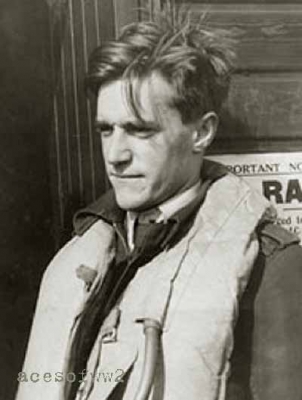 Name : Robert Alexande "Butch" Barton Born : 7th June 1916 Died : 2nd September 2010 Service Number : 37664 Air Victories : 16.00 Awards : Distinguished Flying Cross with 1 Bar |
After training as a pilot he joined No 41 Squadron, flying biplane fighters. Following the outbreak of war he joined the newly-formed No 249 Squadron, whose CO was Squadron Leader John Grandy, later Chief of the Air Staff and a Marshal of the RAF. In December 1940 Barton was promoted to take command of 249 Squadron, and he destroyed two more enemy fighters. In 1941 his squadron was ordered to prepare for service in Malta, and on May 19 its Hurricanes were transferred to Ark Royal in Gibraltar. Barton opened his account in Malta on June 3, when he shot down an Italian bomber, the squadron's first victory over the island. Five days later he destroyed another bomber, this time at night. At first light, he returned to the scene to search for the Italian crew. Two men were found and rescued. Under Barton's leadership, 249 Squadron was one of the most successful fighter squadrons on the island. But on July 31 he was lucky to survive when the engine of his Hurricane failed as he took off and he crashed through some sturdy Maltese walls. His injuries included second-degree burns, and he was kept in hospital for several weeks. Yet by September he was back leading the squadron, and was soon involved in a fierce battle with Italian fighters, during which he was credited with shooting down one and damaging another. On November 22 he achieved his final victory when he shot down a Macchi MC202 fighter near Gozo. After two years' continuous and intense fighting, in December he was rested and returned to England. His deputy, Tom Neil (himself a Battle of Britain ace), wrote: "I was very conscious of the squadron's debt to him. Small and slight in stature, in no way a heroic figure and unassuming almost to a fault, he was a wonderful leader and one of the best fighter pilots it would be my good fortune to meet." The citation for the Bar to Barton's DFC concluded that "his excellent leadership inspires the pilots under his command". Following a spell as chief instructor at a fighter training unit, Barton took command of the fighter airfield at Skaebrae in Orkney. He later commanded North Weald and served at HQ Fighter Command, where he was responsible for tactics. He was mentioned in despatches and in June 1945 was appointed OBE. In August 1945 he was posted to India, and then for two years helped in the creation of the Pakistan Air Force following Partition. Barton served on a number of fighter stations and commanded RAF Acklington in Northumberland. His final appointment was on the operations staff at the Air Ministry, and he retired in February 1959. |
COMBAT REPORTS |
October 22nd, 1941 DFC Citation: "This officer has displayed outstanding leadership and has contributed materially to the many successes obtained by his squadron. His skill was particularly displayed on the 28th September when his squadron was responsible for destroying twenty enemy aircraft. Flight Lieutenant Barton has personally destroyed four enemy aircraft and shared in the destruction of others." October 31st, 1941 DFC Bar Citation: "Squadron Leader Barton is Officer Commanding No.249 Squadron. During his period of service in the United Kingdom this officer shot down seven and one-half enemy aircraft confirmed and since his arrival in Malta has show down four and one-half enemy aircraft including one enemy bomber at night. He shows a high standard of courage and initiative and his excellent leadership has been a tonic to his flight commanders and fellow pilots and to the station in general. He leads his squadron on all interceptions and offensive fighter patrols which entails being on "Standby" every other day. In addition to this he performs night fighter duties which on many occasions have entailed being on watch for the entire 24 hours without a break. The results obtained by the fighter effort on the island of Malta can be largely credited to the efforts of this officer in the manner in which he inspires the pilots under his command. This was edited down for the Honours and Awards Committee at Air Ministry: This officer destroyed seven hostile aircraft during a period of service in the United Kingdom. Since his arrival in Malta he has led his squadron on all interceptions and fighter patrols during which he has destroyed four hostile aircraft, including one at night. Squadron Leader Barton has, throughout, shown a high standard of courage, leadership and initiative and has contributed materially to the results obtained by the fighter effort on the island." Details: Second DFC received as a bar for on the ribbon of the first DFC. Published in The London Gazette, dated 31st October 1941. |
Photos Submitted Through Our Directory |
 |
| Aircraft for : Robert Alexande "Butch" Barton | ||
| A list of all aircraft associated with Robert Alexande "Butch" Barton. A profile page including a list of all art prints for the aircraft is available by clicking the aircraft name. | ||
| Aircraft | Info | |
Hurricane 
Manufacturer : Hawker Production Began : 1936 Number Built : 14533 | Hurricane Royal Air Force Fighter, the Hawker Hurricane had a top speed of 320mph, at 18,200 feet and 340mph at 17,500, ceiling of 34,200 and a range of 935 miles. The Hurricane was armed with eight fixed wing mounted .303 browning machine guns in the Mark I and twelve .303 browning's in the MKIIB in the Hurricane MKIIC it had four 20mm cannon. All time classic fighter the Hurricane was designed in 1933-1934, the first prototype flew in June 1936 and a contract for 600 for the Royal Air Force was placed. The first production model flew ion the 12th October 1937 and 111 squadron of the Royal Air Force received the first Hurricanes in January 1938. By the outbreak of World war two the Royal Air Force had 18 operational squadrons of Hurricanes. During the Battle of Britain a total of 1715 Hurricanes took part, (which was more than the rest of the aircraft of the Royal air force put together) and almost 75% of the Victories during the Battle of Britain went to hurricane pilots. The Hawker Hurricane was used in all theatres during World war two, and in many roles. in total 14,533 Hurricanes were built. | |
| Squadrons for : Robert Alexande "Butch" Barton | ||
| A list of all squadrons known to have been served with by Robert Alexande "Butch" Barton. A profile page is available by clicking the squadron name. | ||
| Squadron | Info | |
No.249 Sqn RAF Country : UK Founded : 18th August 1918 Fate : Disbanded 24th February 1969 Gold Coast Pugnis et cacibus - With fist and heels | No.249 Sqn RAF Full profile not yet available. | |
Return to Aviation Directory Search Home
|
Everything we obtain for this site is shown on the site, we do not have any more photos, crew lists or further information on any of the ships. COPYRIGHT NOTICE. ALL IMAGES DISPLAYED ON THIS WEBSITE ARE PROTECTED BY COPYRIGHT LAW, AND ARE OWNED BY CRANSTON FINE ARTS OR THEIR RESPECTIVE OWNERS. NO REPRODUCTION OR COPYING ALLOWED ON OTHER WEBSITES, BOOKS OR ARTICLES WITHOUT PRIOR AGREEMENT. |
|
Contact Details |
|
Sign Up To Our Newsletter!
This website is owned by Cranston Fine Arts. Torwood House, Torwoodhill Road, Rhu, Helensburgh, Scotland, G848LE Contact: Tel: (+44) (0) 1436 820269. Email: cranstonorders -at- outlook.com |
 |

