|
|
|
|
|
|

|
Naval History by Country :
|
|||||||||||||
| VIEW ALL OF OUR CURRENT ART SPECIAL OFFERS ON ONE PAGE HERE | |||
| NAVAL ART | AVIATION ART | MILITARY ART | SPORT ART |
|
|
Charles N Baisden |
|
Name : Charles N Baisden |
Chuck Baisden was born in 1920 in Scranton, Pennsylvania. He joined the Army Air Corps in 1939, and by late 1940 he found himself working with aircraft such as the P-36, P-40, YP-37 and Bell Airacuda. When he joined the AVG in 1941, he had his reasons.... "I went from making $72 a month in the Army to $350 a month with the Flying Tigers. That was a lot of money in those days." The new job also provided him an opportunity to travel and work in his field as an ordnance expert and he was assigned to the Hells Angles squadron, to put his talents to good use. One of the youngest to join the AVG, he remembers "I had just turned twenty-one in March before leaving for China in May of 1941.. just bought my first beer." After the AVG, Chuck re-enlisted. He entered pilot training school and it was back to China, now part of the famed 1st Air Commando Group. He eventually flew 58 missions as Engineer / Turret gunner of a B-25 squadron, one of whose pilots was R T Smith, a close friend from his AVG days. After WWII, he flew as a B-29 gunner in the Korean War. By 1960 he had completed some 815 refuelling missions, and in 1964 he retired from the Air Force. |
Artwork signed by this Pilot or Aircrew |
  Shark Sighting by John D Shaw. |  Summer of 42 by John D Shaw. |
| Aircraft for : Charles N Baisden | ||
| A list of all aircraft associated with Charles N Baisden. A profile page including a list of all art prints for the aircraft is available by clicking the aircraft name. | ||
| Aircraft | Info | |
Mitchell 
| Mitchell On April 18, 1942, Lt. Col. James H. Doolittle led a group of 16 B-25 bombers on a carrier-launched raid on industrial and military targets in Japan. The raid was one of the most daring missions of WW II. Planning for this secret mission began several months earlier, and Jimmy Doolittle, one of the most outstanding pilots and leaders in the United States Army Air Corps was chosen to plan, organize and lead the raid. The plan was to get within 300 or 400 miles of Japan, attack military and industrial targets in Tokyo, Osaka, and Kobe shortly after nightfall, and then fly on to a dawn landing at secret airfields on the coast of China. The twin engine B-25 Mitchell bomber was selected by Doolittle for the mission and practice indicated that it should be possible to launch these aircraft from a carrier deck with less than 500 feet of runway. On April 2, 1942 the USS Hornet and a number of escorts set sail from Alameda, California with the 16 B-25s strapped to its deck. This task force rendezvoused with another including the USS Enterprise, and proceeded for the Japanese mainland. An element of surprise was important for this mission to succeed. When the task force was spotted by a Japanese picket boat, Admiral Halsey made the decision to launch the attack earlier than was planned. This meant that the raiders would have to fly more than 600 miles to Japan, and would arrive over their targets in daylight. It also meant that it would be unlikely that each aircraft would have sufficient fuel to reach useable airfields in China. Doolittle had 50 gallons of additional fuel stowed on each aircraft as well as a dinghy and survival supplies for the likely ditchings at sea which would now take place. At approximately 8:00 AM the Hornets loudspeaker blared, Now hear this: Army pilots, man your planes! Doolittle and his co-pilot R.E. Cole piloted the first B-25 off the Hornets deck at about 8:20 AM. With full flaps, and full throttle the Mitchell roared towards the Hornets bow, just barely missing the ships island superstructure. The B-25 lifted off, Doolittle leveled out, and made a single low altitude pass down the painted center line on the Hornets deck to align his compass. The remaining aircraft lifted off at approximately five minute intervals. The mission was planned to include five three-plane sections directed at various targets. However, Doolittle had made it clear that each aircraft was on its own. He insisted, however, that civilian targets be avoided, and under no circumstances was the Imperial Palace in Tokyo to be bombed. About 30 minutes after taking off Doolittles B-25 was joined by another piloted by Lt. Travis Hoover. These two aircraft approached Tokyo from the north. They encountered a number of Japanese fighter or trainer aircraft, but they remained generally undetected at their low altitude. At 1:30 PM the Japanese homeland came under attack for the first time in the War. From low altitudes the raiders put their cargoes of four 500 pounders into a number of key targets. Despite antiaircraft fire, all the attacking aircraft were unscathed. The mission had been a surprise, but the most hazardous portion of the mission lay ahead. The Chinese were not prepared for the raiders arrival. Many of the aircraft were ditched along the coast, and the crews of other aircraft, including Doolittles were forced to bail out in darkness. There were a number of casualties, and several of the raiders were caught by Japanese troops in China, and some were eventually executed. This painting is dedicated to the memories of those airmen who made the ultimate sacrifice for their country and the thousands of innocent Chinese citizens which were brutally slaughtered as a reprisal for their assistance in rescuing the downed crews. | |
Superfortress 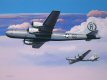
| Superfortress The largest and most powerful bomber of WW II, the Boeing B-29 Super Fortress, played a major role in bringing about the defeat of Japan. In addition to accelerating Japans surrender following the bombing of Hiroshima and Nagasaki with atomic bombs, thousands of B-29 crews flew tens of thousands of bombing missions against Japan from bases in China, India, and later in the War from recaptured islands in the Pacific. B-29s entered service in 1943 following a lengthy, problem-filled, development process of three years in response to the governments request for a long range strategic bomber. Only Boeing and Douglas (the B-32 Dominator) responded to the governments requests, and the B-32 had even greater development problems than the B-29. Powered by four giant Wright R-3350-23 radial engines generating a total horsepower of 8,924, the Super Fortresses typically carried crews of ten. They were capable of a top speed of 357-MPH, and at slower cruising speeds had a range of more than 3,200 miles. The B-29 was a large aircraft for its time with a wingspan in excess of 140 feet and a length of just under 100 feet. The Super Forts also had pressurized forward and aft hulls, which made the long distance missions a bit more comfortable for the flight crews. B-29s typically carried defensive armament which included ten machine guns and a single tail-mounted canon. Because of the pressurized hull, the guns were operated by remote control. The first operational B-29 wing was the 58th which flew out of the China-Burma-India theater. On March 9, 1945 General Curtis LeMay ordered an unusual low altitude attack on Tokyo by hundreds of B-29s carrying incendiary bombs. Five such low level missions were scheduled over a ten-day period, and the combined destruction of these missions exceeded that of either of the atomic bomb missions. B-29s were also effectively used to mine Japanese ports and shipping lanes. | |
Warhawk 
Manufacturer : Curtiss Production Began : 1938 Retired : 1958 Number Built : 13738 | Warhawk P-40 | |
| Squadrons for : Charles N Baisden | ||
| A list of all squadrons known to have been served with by Charles N Baisden. A profile page is available by clicking the squadron name. | ||
| Squadron | Info | |
American Volunteer Group Country : US (AVG) Financially backed by China to defend against Japanese attack, prior to American entering the war. Pilots awarded $500 bounty for each aircraft destroyed. Click the name above to see prints featuring aircraft of American Volunteer Group | American Volunteer Group Full profile not yet available. | |
Return to Aviation Directory Search Home
|
Everything we obtain for this site is shown on the site, we do not have any more photos, crew lists or further information on any of the ships. COPYRIGHT NOTICE. ALL IMAGES DISPLAYED ON THIS WEBSITE ARE PROTECTED BY COPYRIGHT LAW, AND ARE OWNED BY CRANSTON FINE ARTS OR THEIR RESPECTIVE OWNERS. NO REPRODUCTION OR COPYING ALLOWED ON OTHER WEBSITES, BOOKS OR ARTICLES WITHOUT PRIOR AGREEMENT. |
|
Contact Details |
|
Sign Up To Our Newsletter!
This website is owned by Cranston Fine Arts. Torwood House, Torwoodhill Road, Rhu, Helensburgh, Scotland, G848LE Contact: Tel: (+44) (0) 1436 820269. Email: cranstonorders -at- outlook.com |
 |

