|
|
|
|
|
|

|
Naval History by Country :
|
|||||||||||||
| VIEW ALL OF OUR CURRENT ART SPECIAL OFFERS ON ONE PAGE HERE | |||
| NAVAL ART | AVIATION ART | MILITARY ART | SPORT ART |
|
|
Malcolm Scott |
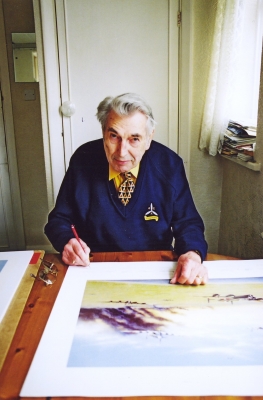 Malcolm Scott Name : Malcolm Scott Awards : Distinguished Flying Cross |
Flew with 180 Squadron on Mitchells 1944 - 1945. Bomber Navigator/ B with 34, 180 ( Bomber Command) and 29 Squadron. He did two tours of operations – 1st M.E.T.O. & F.E.T.O. on Blenheims 36 ops and 2nd E.T.O. on Mitchells and Mosquitos 38 ops. He volunteered in July 1940 ( RAFVR). |
Known Service Details : | |||||||
Squadron | Rank | Start of Service | End of Service | Known Dates | Aircraft | Airframes | Notes |
1944 | 1945 | ||||||
unknown | unknown | ||||||
unknown | unknown | ||||||
Artwork signed by this Pilot or Aircrew |
  Returning from Caen by Graeme Lothian. |
Photos Submitted Through Our Directory |
 Malcolm Scott Signing the art print Returning from Caen by Graeme Lothian. |
| Aircraft for : Malcolm Scott | ||
| A list of all aircraft associated with Malcolm Scott. A profile page including a list of all art prints for the aircraft is available by clicking the aircraft name. | ||
| Aircraft | Info | |
Blenheim 
Manufacturer : Bristol Production Began : 1935 Retired : 1956 Number Built : 4422 | Blenheim The Bristol Blenheim, the most plentiful aircraft in the RAFs inventory when WWII began, was designed by Frank Barnwell, and when first flown in 1936 was unique with its all metal monoplane design incorporating a retractable undercarriage, wing flaps, metal props, and supercharged engines. A typical bomb load for a Blenheim was 1,000 pounds. In the early stages of the war Blenheims were used on many daylight bombing missions. On the day that war was declared on Germany, a Blenheim piloted by Flying Officer Andrew McPherson was the first British aircraft to cross the German coast and the following morning 15 Blenheims from three squadrons set off on one of the first bombing missions The Blenheim units operated throughout the battle, often taking heavy casualties, although they were never accorded the publicity of the fighter squadrons. The Blenheim units raided German occupied airfields throughout July to December 1940, both during daylight hours and at night. Although most of these raids were unproductive, there were some successes; on 1 August five out of 12 Blenheims sent to attack Haamstede and Evere (Brussels) were able to bomb, destroying or heavily damaging three Bf 109s of II./JG 27 and apparently killing a Staffelkapitän identified as Hauptmann Albrecht von Ankum-Frank. Two other 109s were claimed by Blenheim gunners. Another successful raid on Haamstede was made by a single Blenheim on 7 August which destroyed one 109 of 4./JG 54, heavily damaged another and caused lighter damage to four more. There were also some missions which produced an almost 100% casualty rate amongst the Blenheims. One such operation was mounted on 13 August 1940 against a Luftwaffe airfield near Aalborg in north-western Denmark by 12 aircraft of 82 Squadron. One Blenheim returned early (the pilot was later charged and due to appear before a court martial, but was killed on another operation); the other 11, which reached Denmark, were shot down, five by flak and six by Bf 109s. Blenheim-equipped units had been formed to carry out long-range strategic reconnaissance missions over Germany and German-occupied territories, as well as bombing operations. In this role, the Blenheims once again proved to be too slow and vulnerable against Luftwaffe fighters and they took constant casualties While great heroism was displayed by the air crews, tremendous losses were sustained during these missions. The Blenhiem was easy pickings at altitude for German Bf-109 fighters who quickly learned to attack from below. To protect the vulnerable bellies of the Blenheims many missions were shifted to low altitude, but this increased the aircrafts exposure to anti-aircraft fire. In the German night-bombing raid on London on 18 June 1940, Blenheims accounted for five German bombers, thus proving that they were better-suited for night fighting. In July, No. 600 Squadron, by then based at RAF Manston, had some of its Mk IFs equipped with AI Mk III radar. With this radar equipment, a Blenheim from the Fighter Interception Unit (FIU) at RAF Ford achieved the first success on the night of 2–3 July 1940, accounting for a Dornier Do 17 bomber. More successes came, and before long the Blenheim proved itself invaluable as a night fighter. One Blenheim pilot, Squadron Leader Arthur Scarf, was posthumously awarded the Victoria Cross for an attack on Singora, Thailand, on 9 December 1941. Another bomber of No. 60 Squadron RAF was credited with shooting down Lt Col Tateo Katō's Nakajima Ki-43 fighter and badly damaging two others in a single engagement on 22 May 1942, over the Bay of Bengal. Katō's death was a severe blow to the Imperial Japanese Army Air Force. | |
Mitchell 
| Mitchell On April 18, 1942, Lt. Col. James H. Doolittle led a group of 16 B-25 bombers on a carrier-launched raid on industrial and military targets in Japan. The raid was one of the most daring missions of WW II. Planning for this secret mission began several months earlier, and Jimmy Doolittle, one of the most outstanding pilots and leaders in the United States Army Air Corps was chosen to plan, organize and lead the raid. The plan was to get within 300 or 400 miles of Japan, attack military and industrial targets in Tokyo, Osaka, and Kobe shortly after nightfall, and then fly on to a dawn landing at secret airfields on the coast of China. The twin engine B-25 Mitchell bomber was selected by Doolittle for the mission and practice indicated that it should be possible to launch these aircraft from a carrier deck with less than 500 feet of runway. On April 2, 1942 the USS Hornet and a number of escorts set sail from Alameda, California with the 16 B-25s strapped to its deck. This task force rendezvoused with another including the USS Enterprise, and proceeded for the Japanese mainland. An element of surprise was important for this mission to succeed. When the task force was spotted by a Japanese picket boat, Admiral Halsey made the decision to launch the attack earlier than was planned. This meant that the raiders would have to fly more than 600 miles to Japan, and would arrive over their targets in daylight. It also meant that it would be unlikely that each aircraft would have sufficient fuel to reach useable airfields in China. Doolittle had 50 gallons of additional fuel stowed on each aircraft as well as a dinghy and survival supplies for the likely ditchings at sea which would now take place. At approximately 8:00 AM the Hornets loudspeaker blared, Now hear this: Army pilots, man your planes! Doolittle and his co-pilot R.E. Cole piloted the first B-25 off the Hornets deck at about 8:20 AM. With full flaps, and full throttle the Mitchell roared towards the Hornets bow, just barely missing the ships island superstructure. The B-25 lifted off, Doolittle leveled out, and made a single low altitude pass down the painted center line on the Hornets deck to align his compass. The remaining aircraft lifted off at approximately five minute intervals. The mission was planned to include five three-plane sections directed at various targets. However, Doolittle had made it clear that each aircraft was on its own. He insisted, however, that civilian targets be avoided, and under no circumstances was the Imperial Palace in Tokyo to be bombed. About 30 minutes after taking off Doolittles B-25 was joined by another piloted by Lt. Travis Hoover. These two aircraft approached Tokyo from the north. They encountered a number of Japanese fighter or trainer aircraft, but they remained generally undetected at their low altitude. At 1:30 PM the Japanese homeland came under attack for the first time in the War. From low altitudes the raiders put their cargoes of four 500 pounders into a number of key targets. Despite antiaircraft fire, all the attacking aircraft were unscathed. The mission had been a surprise, but the most hazardous portion of the mission lay ahead. The Chinese were not prepared for the raiders arrival. Many of the aircraft were ditched along the coast, and the crews of other aircraft, including Doolittles were forced to bail out in darkness. There were a number of casualties, and several of the raiders were caught by Japanese troops in China, and some were eventually executed. This painting is dedicated to the memories of those airmen who made the ultimate sacrifice for their country and the thousands of innocent Chinese citizens which were brutally slaughtered as a reprisal for their assistance in rescuing the downed crews. | |
Mosquito 
Manufacturer : De Havilland Production Began : 1940 Retired : 1955 Number Built : 7781 | Mosquito Used as a night fighter, fighter bomber, bomber and Photo-reconnaissance, with a crew of two, Maximum speed was 425 mph, at 30,300 feet, 380mph at 17,000ft. and a ceiling of 36,000feet, maximum range 3,500 miles. the Mosquito was armed with four 20mm Hospano cannon in belly and four .303 inch browning machine guns in nose. Coastal strike aircraft had eight 3-inch Rockets under the wings, and one 57mm shell gun in belly. The Mossie at it was known made its first flight on 25th November 1940, and the mosquito made its first operational flight for the Royal Air Force as a reconnaissance unit based at Benson. In early 1942, a modified version (mark II) operated as a night fighter with 157 and 23 squadron's. In April 1943 the first De Haviland Mosquito saw service in the Far east and in 1944 The Mosquito was used at Coastal Command in its strike wings. Bomber Commands offensive against Germany saw many Mosquitos, used as photo Reconnaissance aircraft, Fighter Escorts, and Path Finders. The Mosquito stayed in service with the Royal Air Force until 1955. and a total of 7781 mosquito's were built. | |
| Squadrons for : Malcolm Scott | ||
| A list of all squadrons known to have been served with by Malcolm Scott. A profile page is available by clicking the squadron name. | ||
| Squadron | Info | |
No.180 Sqn RAF Country : UK Founded : 11th September 1942 Fate : Disbanded 31st March 1946 Suaviter in modo fortiter in re - Agreeable in manner, forcible in act | No.180 Sqn RAF Full profile not yet available. | |
No.29 Sqn RAF Country : UK Founded : 7th November 1915 Impiger et acer - Energetic and keen | No.29 Sqn RAF No 29 Squadron was formed at Gosport on 7 November 1915 from a nucleus supplied by No 23 Squadron, and after training moved to France in March 1916 as the third squadron to be fully equipped with fighters. Its DH2s were engaged in escort duties to protect the slow and vulnerable reconnaissance aircraft over the Western Front ,By late 1916 the DH.2 was outclassed by new German fighters, but No. 29 kept its pushers until March 1917, when it was re-equipped with Nieuport 17s. These were replaced with later Nieuport types, such as the Nieuport 24bis, as these became available. Due to a shortage of the Royal Aircraft Factory S.E.5a the squadron retained its Nieuports until April 1918, being replaced by SE5As, which were used for the rest of the war on fighter and ground -attack missions. After a short period in Germany, the squadron Squadron was reduced to a cadre and in August 1919 returned to Spittlegate in the UK, in August 1919 where it was disbanded on 31 December 1919. The squadron was reformed on 1 April 1923, initially equipped with Sopwith Snipes. These were replaced by Gloster Grebes in January 1925, In turn, these were replaced by the Armstrong Whitworth Siskin IIIA in March 1928 and Bristol Bulldogs in June 1932. In March 1935, the squadron received two-seater Hawker Demons, which it operated until 1938. This included service in Egypt from October 1935 to 1936, during the Abyssinian crisis. The squadron also operated a few old Fairey Gordons for night patrols in Egypt. No 29 began the Second World War with its Blenheims, which at the period operated as day fighters – especially on convoy protection patrols. From June 1940 it became a night fighter squadron, receiving some of the first Beaufighters in November, though it was February 1941 before the squadron was fully equipped with the new fighter. Various marks of the de Havilland Mosquito were flown by the squadron from May 1943 culminating in the Mosquito NF30. From the middle of 1944 most of the squadron’s missions took it over the continent. The Mosquitoes continued to serve until replaced by Meteors in August 1951 at Tangmere. In January 1957 the squadron Squadron moved north, first to Northumberland and then in July 1958 to Scotland, conversion to Javelins taking having taken place in November 1957. In February 1963, No 29 was moved to Cyprus and in December 1965 went detached to Zambia for nine months on detachmentduring the Rhodesian crisis. In May 1967 the squadron Squadron returned to the UK to become are-equip with Lightnings squadron, disbanding on 31 December 1974. No 29 reformed at Coningsby as a Phantom squadron on 1 January 1975. A detachment was provided for the defence of the Falklands as soon as the airfield at Stanley was capable of operating Phantoms at the endin August of 1982. This became No 23 Squadron in March 1983 The Squadron swapped its Phantoms for Tornado F3 fighters in 1987 remaining at Coningsby until disbanded in October 1998. Five years later, the squadron was reformed, this time as the Typhoon operational conversion unit (OCU) based at BAE Systems' Warton airfield. In April 1987, No 29 Squadron became the first operational squadron to be equipped with the Tornado F3, deploying to Saudi Arabia after the Iraqi invasion of Kuwait in August 1990 and flying throughout Operation DESERT STORM in the air-defence role. The Squadron was again disbanded in October 1998. | |
No.34 Sqn RAF Country : UK Founded : 12th January 1916 Fate : Disbanded 31st December 1967 Lupus vult, lupus volat - Wolf wishes, wolf flies | No.34 Sqn RAF Full profile not yet available. | |
Return to Aviation Directory Search Home
|
Everything we obtain for this site is shown on the site, we do not have any more photos, crew lists or further information on any of the ships. COPYRIGHT NOTICE. ALL IMAGES DISPLAYED ON THIS WEBSITE ARE PROTECTED BY COPYRIGHT LAW, AND ARE OWNED BY CRANSTON FINE ARTS OR THEIR RESPECTIVE OWNERS. NO REPRODUCTION OR COPYING ALLOWED ON OTHER WEBSITES, BOOKS OR ARTICLES WITHOUT PRIOR AGREEMENT. |
|
Contact Details |
|
Sign Up To Our Newsletter!
This website is owned by Cranston Fine Arts. Torwood House, Torwoodhill Road, Rhu, Helensburgh, Scotland, G848LE Contact: Tel: (+44) (0) 1436 820269. Email: cranstonorders -at- outlook.com |
 |

