|
|
|
|
|
|

|
Naval History by Country :
|
|||||||||||||
| VIEW ALL OF OUR CURRENT ART SPECIAL OFFERS ON ONE PAGE HERE | |||
| NAVAL ART | AVIATION ART | MILITARY ART | SPORT ART |
|
|
Laurence Larry Godfrey Lewis |
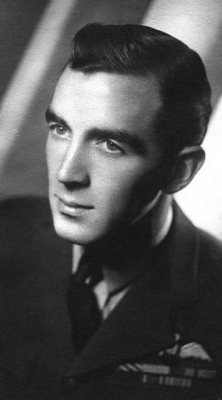 Larry Lewis Name : Laurence Larry Godfrey Lewis Born : 25th October 1918 Died : 12th May 2014 Awards : Distinguished Flying Cross Distinguished Flying Medal |
Squadron Leader Larry Lewis (born October 25th 1918 in Bristol, died May 12th 2014) earned the DFM as an air gunner before training as a pilot. After picking up air crash survivors from behind Japanese-held lines in Siam, he was awarded the DFC. On May 29th 1945 Japanese fighters shot down a Liberator bomber of 358 Squadron over Siam (Thailand) during a flight to drop supplies and US Special Forces to the 'Seri Thai' (Free Thailand) Resistance movement. Some of the crew and passengers survived the crash landing and were sheltered by natives and police. Once SOE in India had been alerted to the plight of the survivors, a rescue mission was mounted. On June 14th Lewis took off in his Dakota and flew at very low level to a remote airstrip at Pukio in Siam. He found the short runway adequate but the aircraft became bogged down at the end of the landing run. Within an hour, however, it had been recovered with the aid of Siamese workers and Lewis took off with seven passengers, including some of the crew of the crashed Liberator. The citation to his DFC concluded, he successfully completed a mission well into enemy territory, in daylight. The results obtained are an excellent tribute to his outstanding ability. One of seven children, Laurence 'Larry' Godfrey Lewis was born in Bristol on October 25 1918 and educated at Bristol Grammar School. He won a Pelaquin Scholarship but had to leave school at 15 to help support his family. He joined the Auxiliary Air Force as a metal rigger in May 1939 and served with No 501 (County of Gloucester) Squadron. Equipped with Hurricane fighters, and based in the south of England, the squadron was heavily involved during the Battle of Britain. Lewis volunteered for pilot training but was selected to be an air gunner, commencing his training in late 1940. At the end of the year he was posted to No.12 Squadron equipped with the Wellington bomber. During a daylight attack on Brest, his aircraft was attacked by a German fighter, which he engaged and probably shot down. He completed 33 operations over enemy territory as a rear gunner including the three 'Thousand Bomber Raids' in the spring of 1942. He was awarded the DFM for his outstanding keenness, reliability and devotion to duty. Lewis was finally selected for pilot training, which he completed in Canada where he converted to the Dakota. He arrived in the Far East in January 1945 and joined No 357 (Special Duties) Squadron at Jessore near Calcutta. Over the next six months he completed 42 operations dropping supplies and agents over Burma and Siam. Some of these long-range missions involved flying over enemy territory for many hours and in extreme weather conditions to find small clearings marked by flares and cloth panels. Some areas were so small that as many as eight or nine runs were necessary before all the loads could be dropped, sometimes from heights of 100 feet. After the capture of Rangoon, flights were mounted from advanced airfields when sorties could be mounted deep into Siam, Indo-China and Malaya in support of clandestine forces. Lewis flew his final sortie on August 3rd 1945 when he made eleven runs to drop his 'packages' over a clearing in southern Burma. After serving at Air HQ Burma in a plans appointment, Lewis was released form the RAF in March 1946. He received the Air Efficiency Award. |
Known Service Details : | |||||||
Squadron | Rank | Start of Service | End of Service | Known Dates | Aircraft | Airframes | Notes |
January 1945 | March 1946 | ||||||
1939 | 1940 | ||||||
1940 | unknown | ||||||
Artwork signed by this Pilot or Aircrew |
  Dawn Return by Anthony Saunders. (APB) |  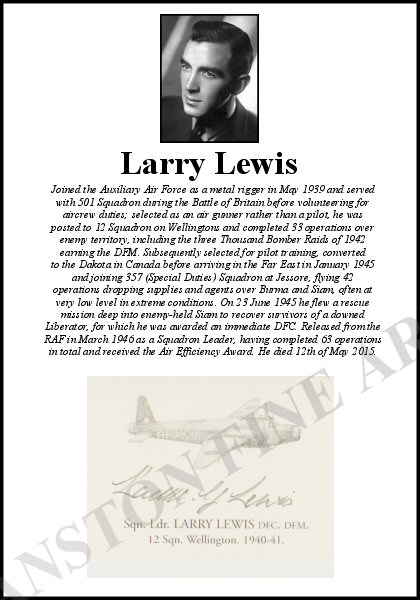 Clipped Signature - Larry Lewis |   Dakota Over Burma by Geoff Lea. (AP) |
  Lancaster VC by Graeme Lothian. |   Larry Lewis DFC by Graeme Lothian. |   Returning from Caen by Graeme Lothian. |
  Crewing Up by Graeme Lothian. |   Wimpey Wonderland by Keith Aspinall. (B) |   Wellingtons by Keith Woodcock. (B) |
Photos Submitted Through Our Directory |
 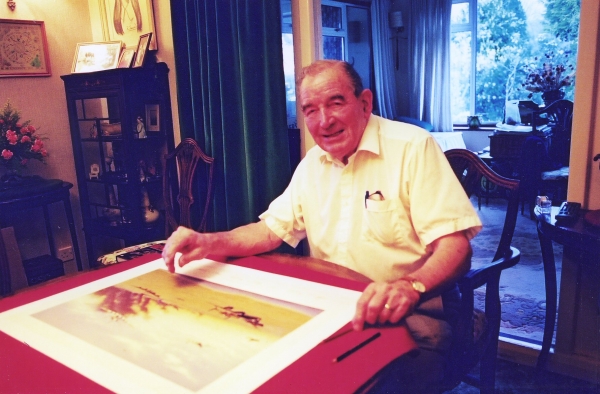 Larry Lewis Signing the print Returning from Caen by Graeme Lothian. |  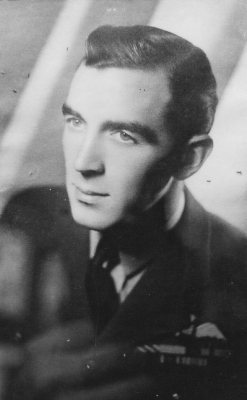 Larry Lewis |  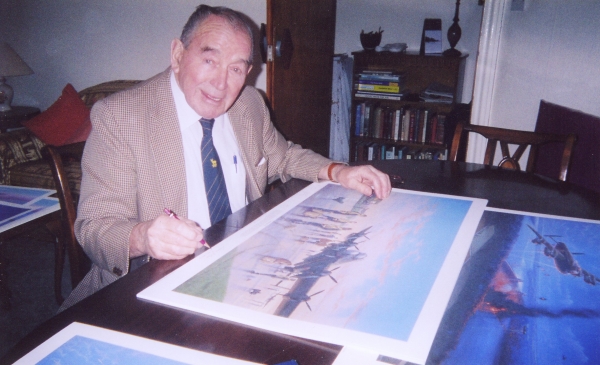 Larry Lewis Signing the print Crewing Up by Graeme Lothian. |  Larry Lewis |
| Aircraft for : Laurence Larry Godfrey Lewis | ||
| A list of all aircraft associated with Laurence Larry Godfrey Lewis. A profile page including a list of all art prints for the aircraft is available by clicking the aircraft name. | ||
| Aircraft | Info | |
Dakota 
Manufacturer : Douglas Production Began : 1941 Retired : 1970 | Dakota DOUGLAS DAKOTA, Transport aircraft with three crew and can carry 28 passengers. speed 230-mph, and a altitude of 23,200 feet. maximum range 2,100 miles. The Douglas Dakota served in all theatres of world war two, The Royal Air Force received its first Douglas Dakota's in April 1941, to 31 squadron which was serving in India. These were DC2, later DC3 and eventually C-47 Dakotas were supplied. The Douglas Dakota was developed from the civil airliner of the 1930's. The Royal Air Force received nearly 2,000 Dakotas, But many more than this served in the US Air Force and other allied countries. The last flight of a Douglas Dakota of the Royal Air Force was in 1970. You can still see Douglas Dakota's in operational and transport use across the world. | |
Wellington 
Manufacturer : Vickers Production Began : 1938 Retired : 1953 | Wellington The Vickers Wellington was a Bomber aircraft and also used for maritime reconnaissance. and had a normal crew of six except in the MKV and VI where a crew of three was used. Maximum speed was 235 mph (MK1c) 255 mph (MK III, X) and 299 mph (MK IIII), normal operating range of 1805 miles (except MK III which was 1470miles) The Wellington or Wimpy as it was known, was the major bomber of the Royal Air Force between 1939 and 1943. The Royal Air Force received its first Wellingtons in October 1938 to 99 squadron. and by the outbreak of World war two there were 6 squadrons equipped with the Vickers Wellington. Due to heavy losses on daylight raids, the Wellington became a night bomber and from 1940 was also used as a long range bomber in North Africa. and in 1942 also became a long range bomber for the royal Air Force in India. It was well used by Coastal Command as a U-Boat Hunter. The Wellington remained in service with the Royal Air Force until 1953. Probably due to its versatile use, The aircraft was also used for experimental work including the fitting of a pressure cabin for High altitude tests. The Vickers Wellington could sustain major damage and still fly, probably due to its construction of its geodesic structure and practical application of geodesic lines. Designed by Sir Barnes Wallis | |
| Squadrons for : Laurence Larry Godfrey Lewis | ||
| A list of all squadrons known to have been served with by Laurence Larry Godfrey Lewis. A profile page is available by clicking the squadron name. | ||
| Squadron | Info | |
No.12 Sqn RAF Country : UK Founded : 14th February 1915 Leads the field | No.12 Sqn RAF No. 12 Squadron Royal Flying Corps was formed on 14th February 1915 from a flight of No. 1 Squadron RFC based at Netheravon Airfield in Wiltshire. The squadron moved to France in September 1915 and operated a variety of aircraft on operations over the Western Front during the First World War. In March 1918, the squadron was re-equipped with the Bristol F.2b Fighter just before becoming part of the newly formed Royal Air Force. The squadron, by then based at Bickendorf in Germany, was disbanded in 1922. The squadron re-formed at RAF Northolt on 1 April 1923, operating the de Havilland DH.9A. In 1924, it moved to RAF Andover in Hampshire and converted to the Fairey . The squadron was the only RAF user of the Fairey Fox and its performance was superior to other types, resulting in the motto of 'Leads the Field'. In 1931, the squadron re-equipped with the Sydney Camm designed Hawker Hart. In October 1935 the squadron moved to the Middle East, but returned to Andover in August 1936. The Harts were replaced by the Hawker Hind in 1936 and in 1938 the squadron was equipped with Fairey Battles. On the first day of the Second World War the squadron moved to France to begin operations. On 12 May 1940, over the Albert Canal, Belgium, one bridge in particular was being used by the invading German Army, with protection from fighter aircraft, anti-aircraft and machine-guns. The RAF was ordered to demolish this vital bridge, and five Fairey Battles from the squadron were dispatched. They met an intensive anti-aircraft fire, but the mission was accomplished, much of the success being due to the coolness and resource of the pilot Flying Officer Garland of the leading aircraft and the navigation of Sergeant Gray. Notwithstanding the success of the mission, the leading aircraft and three others did not return. Flying Officer Garland and Sergeant Gray were both posthumously awarded the Victoria Cross. No. 12 Squadron returned to England in June. It was stationed initially at RAF Finningley in South Yorkshire, before moving to RAF Binbrook in Lincolnshire during July 1940, when it was refurnished with Battles. Amongst other missions, the squadron carried out anti-invasion strikes against shipping in Boulogne Harbour in northern France, most notably on 17 and 19 August. The squadron was one of the last No.1 Group units to conduct operations with Fairey Battles. These took place on 15/16 October 1940, when No. 301 (Polish) Squadron bombed Boulogne and Nos. 12 and 142 Squadrons bombed Calais. By November 1940, the squadron had been re-equipped with the Vickers Wellington medium bomber, remaining for the time being at RAF Binbrook. The squadron moved again in 1942, to RAF Wickenby also in Lincolnshire, and soon after converted to operate the Avro Lancaster a heavy bomber. In 1946 the squadron re-equipped with the Avro Lincoln, another heavy bomber. In 1952, the squadron joined the jet-age and re-equipped with the English Electric Canberra jet bomber. After 44 years continuous service the squadron was again disbanded in July 1961. In 1962, the squadron was re-formed to operate eight Avro Vulcan V bombers equipped with Yellow Sun one megaton free-fall strategic nuclear bombs for medium to high altitude release. The squadron initially operated Vulacns from RAF Coningsby in Lincolnshire and then later from RAF Cottesmore in Rutland. The advent of effective Soviet surface-to-air-missiles made high-flying bombers vulnerable, and in late 1966 the squadron took delivery of eight WE.177B strategic nuclear laydown bombs for low-level penetration missions. It was assigned to Supreme Allied Commander Europe (SACEUR) as part of the UK strategic nuclear forces deployed with that 450 kt weapon, that was intended as a temporary stop-gap until the UK Polaris force began to take over the strategic nuclear delivery role The squadron stood down from this role at the end of 1967 | |
No.357 Sqn RAF Country : UK Founded : 1st February 1944 Fate : Disbanded 15th November 1945 (Special Duties) Mortem hostibus - We bring death to the enemy | No.357 Sqn RAF Full profile not yet available. | |
No.501 Sqn RAF Country : UK Founded : 14th June 1929 Fate : Disbanded 10th March 1957 County of Gloucester, City of Bristol (Auxiliary) Nil time - Fear nothing | No.501 Sqn RAF Full profile not yet available. | |
Return to Aviation Directory Search Home
|
Everything we obtain for this site is shown on the site, we do not have any more photos, crew lists or further information on any of the ships. COPYRIGHT NOTICE. ALL IMAGES DISPLAYED ON THIS WEBSITE ARE PROTECTED BY COPYRIGHT LAW, AND ARE OWNED BY CRANSTON FINE ARTS OR THEIR RESPECTIVE OWNERS. NO REPRODUCTION OR COPYING ALLOWED ON OTHER WEBSITES, BOOKS OR ARTICLES WITHOUT PRIOR AGREEMENT. |
|
Contact Details |
|
Sign Up To Our Newsletter!
This website is owned by Cranston Fine Arts. Torwood House, Torwoodhill Road, Rhu, Helensburgh, Scotland, G848LE Contact: Tel: (+44) (0) 1436 820269. Email: cranstonorders -at- outlook.com |
 |

