|
|
|
|
|
|

|
Naval History by Country :
|
|||||||||||||
| VIEW ALL OF OUR CURRENT ART SPECIAL OFFERS ON ONE PAGE HERE | |||
| NAVAL ART | AVIATION ART | MILITARY ART | SPORT ART |
|
|
Lewis Hodges |
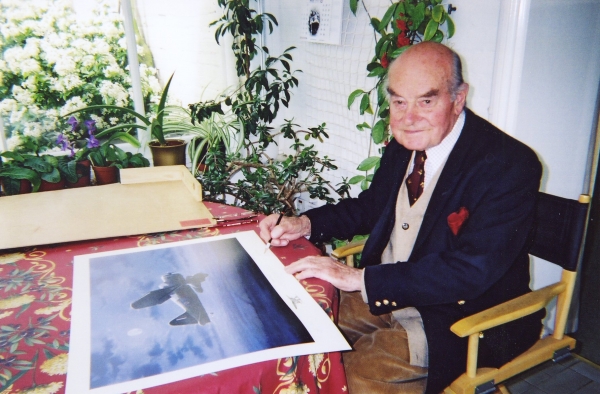 Lewis Hodges Name : Lewis Hodges Died : 4th January 2007 Awards : Distinguished Service Order Distinguished Flying Cross Distinguished Flying Cross with 1 Bar |
Lewis Hodges flew with 49 Sqn from June 1940 until he was shot down over occupied France in Sept 1940 and taken prisoner by the Vichy French. He managed to escape and made his way back to England, rejoining 49 Sqn. He took part in the attacks against the German Channel dash operation in Feb 1942. In Nov of that year he joined 161 (Special Duties) Sqn, flying Halifaxes, Lysanders and Hudsons landing and parachuting agents into German occupied territory. Among the people he brought out of France were two future Presidents - Vincent Auriol and Francois Mitterand. He died 4th January 2007. |
Artwork signed by this Pilot or Aircrew |
  Lysander Pick Up by Graeme Lothian (AP) |   Loire Rendezvous by Philip West. |   Alone at Dawn by Gerald Coulson (AP) |
  They Landed by Moonlight by Robert Taylor. |
Artwork featuring the mounted signature of this Pilot or Aircrew |
  Action This Day by Richard Taylor. (C) |
Photos Submitted Through Our Directory |
 Lewis Hodges Signing the print Lysander Pickup by Graeme Lothian. |
| Aircraft for : Lewis Hodges | ||
| A list of all aircraft associated with Lewis Hodges. A profile page including a list of all art prints for the aircraft is available by clicking the aircraft name. | ||
| Aircraft | Info | |
Halifax 
Manufacturer : Handley Page Production Began : 1941 Retired : 1952 Number Built : 6177 | Halifax Royal Air Force heavy Bomber with a crew of six to eight. Maximum speed of 280mph (with MK.VI top speed of 312mph) service ceiling of 22,800feet maximum range of 3,000 miles. The Halifax carried four .303 browning machine guns in the tail turret, two .303 browning machines in the nose turret in the MK III there were four .303 brownings in the dorsal turret. The Handley Page Halifax, first joined the Royal Air Force in March 1941 with 35 squadron. The Halifax saw service in Europe and the Middle east with a variety of variants for use with Coastal Command, in anti Submarine warfare, special duties, glider-tugs, and troop transportation roles. A total of 6177 Halifax's were built and stayed in service with the Royal Air Force until 1952 | |
Hudson 
Manufacturer : Lockheed Production Began : 1939 Number Built : 2584 | Hudson In 1938, the British Purchasing Commission sought an American maritime patrol aircraft and light bomber for the United Kingdom to support the Royal Air Force's Avro Anson. On 10th December 1938, Lockheed produced a modified version of the Lockheed Model 14 Super Electra which was a commercial airliner and the Hudson Mk I went into production. The Hudson was the first significant aircraft construction contract for the Lockhead Aircraft Corporation with the initial RAF order for 200 Hudsons far surpassed any previous order the company had received. By February 1939, Hudsons began to be delivered. A total of 350 Mk I and 20 Mk II Hudsons were supplied in total. These had two fixed Browning machine guns in the nose and two more in a Boulton Paul dorsal turret. Initially the first batch of Hudsons were supplied to No.224 Squadron RAF based at RAF Leuchers in May 1939. By the start of the war in September 78 Hudsons were in service. Not only did the RAF use the Hudson but the Hudson also served throughout the war with Coastal Command and was also used in transport and training roles as well as delivering agents into occupied France. They were also used extensively with the Royal Canadian Air Force wiht their anti-submarine squadrons. They were operated by RAF Special Duties squadrons for clandestine operations, with No.161 Squadron in Europe and No.357 Squadron operating in Burma. During the war, they were used as maritime patrol aircraft in the Pacific by the US Navy, the RAAF and the Royal New Zealand Air Force. A total of 2,584 Hudsons were built. They began to be withdrawn from front line service in 1944. The Hudson provided the basis for the development of the Lockhead Ventura. | |
Lysander
Manufacturer : Westland Aircraft Production Began : 1938 Retired : 1946 Number Built : 1786 | Lysander The first Lysanders entered service in June 1938, equipping squadrons for army co-operation and were initially used for message-dropping and artillery spotting. When war broke out in Europe, the earlier Mk Is had been largely replaced by Mk IIs, the older machines heading for the Middle East. Some of these aircraft, now designated type L.1, operated with the Chindits of the British Indian Army in the Burma Campaign of the Second World War. Four regular squadrons equipped with Lysanders accompanied the British Expeditionary Force to France in October 1939, and were joined by a further squadron early in 1940. Following the German invasion of France and the low countries on 10 May 1940, the Lysanders were put into action as spotters and light bombers. In spite of occasional victories against German aircraft, they made very easy targets for the Luftwaffe even when escorted by Hurricanes. Withdrawn from France during the Dunkirk evacuation, they continued to fly supply-dropping missions to Allied forces from bases in England; on one mission to drop supplies to troops trapped at Calais, 14 of 16 Lysanders and Hawker Hectors that set out were lost. 118 Lysanders were lost in or over France and Belgium in May and June 1940, of a total of 175 deployed. With the fall of France, it was clear that the type was unsuitable for the coastal patrol and army co-operation role, being described by Air Marshal Arthur Barratt, commander-in-chief of the British Air Forces in France as "quite unsuited to the task; a faster, less vulnerable aircraft was required." Nevertheless, throughout the remainder of 1940, Lysanders flew dawn and dusk patrols off the coast and in the event of an invasion of Britain, they were tasked with attacking the landing beaches with light bombs and machine guns.[9] They were replaced in the home-based army co-operation role from 1941 by camera-equipped fighters such as the Curtiss Tomahawk and North American Mustang carrying out reconnaissance operations, while light aircraft such as the Taylorcraft Auster were used to direct artillery. Some UK-based Lysanders went to work operating air-sea rescue, dropping dinghies to downed RAF aircrew in the English Channel. Fourteen squadrons and flights were formed for this role in 1940 and 1941. In August 1941 a new squadron, No. 138 (Special Duties), was formed to undertake missions for the Special Operations Executive to maintain clandestine contact with the French Resistance. Among its aircraft were Lysander Mk IIIs, which flew over and landed in occupied France. While general supply drops could be left to the rest of No. 138's aircraft, the Lysander could insert and remove agents from the continent or retrieve Allied aircrew who had been shot down over occupied territory and had evaded capture. For this role the Mk IIIs were fitted with a fixed ladder over the port side to hasten access to the rear cockpit and a large drop tank under the belly. In order to slip in unobtrusively the Lysanders were painted matte black; operations almost always took place within a week of a full moon, as moonlight was essential for navigation. The aircraft undertook such duties until the liberation of France in 1944. The Lysanders flew from secret airfields at Newmarket and later Tempsford, but used regular RAF stations to fuel-up for the actual crossing, particularly RAF Tangmere. Flying without any navigation equipment other than a map and compass, Lysanders would land on short strips of land, such as fields, marked out by four or five torches. They were originally designed to carry one passenger in the rear cockpit, but for SOE use the rear cockpit was modified to carry two passengers in extreme discomfort in case of urgent necessity. The pilots of No. 138 and from early 1942, No. 161 Squadron transported 101 agents to and recovered 128 agents from Nazi-occupied Europe. The Germans knew little about the British aircraft and wished to study one. Soldiers captured an intact Lysander in March 1942 when its pilot was unable to destroy it after a crash, but a train hit the truck carrying the Lysander, destroying the cargo | |
| Squadrons for : Lewis Hodges | ||
| A list of all squadrons known to have been served with by Lewis Hodges. A profile page is available by clicking the squadron name. | ||
| Squadron | Info | |
No.161 Sqn RAF Country : UK Founded : 1st June 1918 Fate : Disbanded 2nd June 1945 Liberate | No.161 Sqn RAF Full profile not yet available. | |
No.49 Sqn RAF Country : UK Founded : 15th April 1916 Fate : Disbanded 1st May 1965 Cave canem - Beware of the dog | No.49 Sqn RAF 49 Squadron was formed on 15th April 1916, during the First World War. In the course of the war, it flew DH4 and DH9 aircraft before disbanding in July 1919. Reformed in 1936, they flew Hind and Hampdens before war broke out in 1939. It was in a Hampden of 49 Sqn that Roderick Learoyd won the first Victoria Cross awarded to Bomber Command, when on the night of 12th August 1940, he and four other aircraft attempted to breach the heavily defended Dortmund-Ems canal. The squadron transferred to Manchesters and Lancasters, and after the war to Lincolns, before being disbanded once again on 1st August 1955. Less than a year later, on 1st May 1956, the squadron were reformed, equipped with Valiant V-Bombers of Britain's nuclear deterrent programme, but exactly nine years later, with the aircraft grounded, the squadron disbanded for the last time. | |
Return to Aviation Directory Search Home
|
Everything we obtain for this site is shown on the site, we do not have any more photos, crew lists or further information on any of the ships. COPYRIGHT NOTICE. ALL IMAGES DISPLAYED ON THIS WEBSITE ARE PROTECTED BY COPYRIGHT LAW, AND ARE OWNED BY CRANSTON FINE ARTS OR THEIR RESPECTIVE OWNERS. NO REPRODUCTION OR COPYING ALLOWED ON OTHER WEBSITES, BOOKS OR ARTICLES WITHOUT PRIOR AGREEMENT. |
|
Contact Details |
|
Sign Up To Our Newsletter!
This website is owned by Cranston Fine Arts. Torwood House, Torwoodhill Road, Rhu, Helensburgh, Scotland, G848LE Contact: Tel: (+44) (0) 1436 820269. Email: cranstonorders -at- outlook.com |
 |

