|
|
|
|
|
|

|
Naval History by Country :
|
|||||||||||||
| VIEW ALL OF OUR CURRENT ART SPECIAL OFFERS ON ONE PAGE HERE | |||
| NAVAL ART | AVIATION ART | MILITARY ART | SPORT ART |
|
|
Adolf Galland |
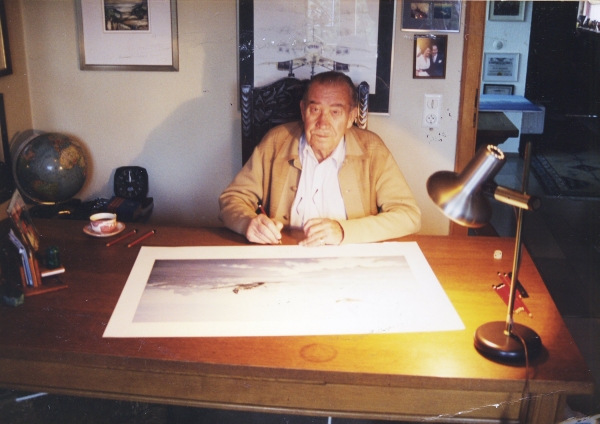 Adolf Galland Name : Adolf Galland Died : 9th February 1996 Air Victories : 104.00 Awards : Knights Cross Oak Leaves to the Knights Cross Swords to the Knights Cross Diamonds to the Knights Cross |
Adolf Galland fought in the great Battles of Poland, France and Britain, leading the famous JG26 'Abbeville Boys'. He flew in combat against the RAF's best including Douglas Bader, Bob Stanford Tuck and Johnnie Johnson. In 1941, at the age of 29, he was promoted to 'Inspector of the Fighter Arm'. In 1942 Hitler personally selected Galland to organise the fighter escort for the 'Channel Dash'. He became the youngest General in the German High Command but open disagreements with Goering led to his dismissal at the end of 1944. He reverted to combat flying, forming the famous JV44 wing flying the Me262 jet fighter, and was the only General in history to lead a squadron into battle. With 104 victories, all in the West, Adolf Galland received the Knight's Cross with Oak Leaves, Swords and Diamonds. Born 19th March 1912, died 9th February 1996. Born in 1911, Adolf Galland learned to fly at a state-sponsored flying club in the early 1930's. In 1933 he was selected to go to Italy for secret pilot training. Galland flew for a brief time as a commercial airline pilot prior to joining the clandestine Luftwaffe as a Second Lieutenant. In April of 1935 he was assigned to JG-2, the Richtofen Fighter Wing, and in 1937 he joined the ranks of the Condor Legion flying the He-51 biplane fighter in support of General Franco during the Spanish Civil War. Despite flying 280 missions, Galland attained no aerial victories, a rather inauspicious start for a pilot would go on to attain more than 100 aerial victories - the highest for any pilot who flew on the Western Front. During Germany's invasion of Poland, Galland was assigned to an attack squadron and he flew over fifty ground sorties. He was promoted to Captain for his efforts, but Galland was anxious to return to a fighter squadron, and he got his wish in October of 1939 when he was transferred to JG-27. It was with JG-27 that Galland first learned to fly the Bf-109. In May of 1940 JG-27 flew in support of the invasion of Belgium, and Galland achieved his first combat victory on May 12. Two months later his score had risen to more than a dozen, and at this time he was once again transferred to JG-26 situated on the Channel Coast. Engaging the RAF on a daily basis during the Battle of Britain, Galland's score rose steadily until it exceeded 40 victories by September. After a short leave Galland rejoined JG-26 in Brittany, where the squadron played a defensive role. Following Germany's invasion of Russia in June of 1941, JG-26 became one of only two German fighter squadrons left on the Channel Coast. This resulted in plenty of flying, and by late in 1941 Galland's victory totals had reached 70. Following a near brush with death when the fuel tank of his 109 exploded, Galland was grounded for a time, and sent to Berlin where he was made the General of the Fighter Arm, reporting directly to Goring and Hitler. Galland spent most of the next few years carrying out inspection tours, and was at odds with his superiors about the need for an adequate fighter defense to negate ever-increasing Allied bombing of Germany's cities. He continued to fly combat missions when the opportunity presented itself, despite Goring's orders to the contrary. In January of 1945 almost 300 fighters were lost in an all-out attack on Allied airfields in France, a mission Galland did not support. He was dismissed as General of the Fighter Arm for his insubordination, but reflecting his flying abilities Hitler ordered Galland to organize JV-44, Germany's first jet-equipped fighter squadron. By March of 1945 Galland had recruited 45 of Germany's best surviving fighter pilots, and this new squadron was given the difficult task of trying to counter the daily onslaught of 15th Air Force bombers coming at Germany from the South. Galland's final mission of the War occurred on April 26 when he attained his 102nd and 103rd confirmed aerial victories prior to crash landing his damaged Me262. Several days later the War was over for both Galland and Germany. General Galland died in 1996. |
Known Service Details : | |||||||
Squadron | Rank | Start of Service | End of Service | Known Dates | Aircraft | Airframes | Notes |
April 1935 | October 1939 | ||||||
Hauptmann | October 1939 | June 1940 | |||||
Oberstleutnant | June 1940 | unknown | 18th November 1941 | ||||
Generalleutnant | March 1945 | 26th April 1945 | |||||
Artwork signed by this Pilot or Aircrew |
  Return from Schweinfurt by Robert Taylor. |   Clipped Signature - Adolf Galland. |   Eagles Over the Steppe by Graeme Lothian. (B) |
  In Defense of the Reich by Nicolas Trudgian. |   Running the Gauntlet by Robert Taylor. (D) |   Most Memorable Day by Robert Taylor. |
  Fighter Legend - Adolf Galland by Nicolas Trudgian. |   Return of the Hunters by Nicolas Trudgian. |   Fighter General by Robert Taylor. |
  Me109 of JG26 by Graeme Lothian. (P) |   The Greatest Day by Robert Taylor. (C) |   Head on Pass by David Pentland. (P) |
  Abbeville Boys by Robert Taylor. |   Aces on the Western Front by Robert Taylor. |   Duel of Eagles by Robert Taylor. |
  Eagle Attack by Robert Taylor. |   Eagles High by Robert Taylor. |   Eagles out of the Sun by Robert Taylor. |
  Gathering of Eagles by Robert Taylor. |   JG52 by Robert Taylor. |   JV44 by Robert Taylor. |
  The Channel Dash by Robert Taylor. |   Stormbirds over the Reich by Robert Taylor. |   Defiant but Doomed by Stan Stokes. (B) |
Artwork featuring the mounted signature of this Pilot or Aircrew |
  Bf109E of III./JG2 - Summer 1940 by Ivan Berryman. (B) |   Gunther Rall - Black 13 by Ivan Berryman. (P) |   The Last Patrol by David Pentland. (L) |
  Adolf Galland by Graeme Lothian. (APB) |   Dawn Eagles Rising by Robert Taylor. (AP) |   Adversaries by Ivan Berryman. (C) |
  Jet Strike by Nicolas Trudgian (AP) |   JG-52 by Robert Taylor. (C) |   The Eagles Divide by Robert Taylor. (E) |
Artwork with companion print(s) featuring the mounted signature of this Pilot or Aircrew |
  Air Armada by Robert Taylor. (C) |   Horrido! by Robert Taylor. (B) |   Jet Hunters by Robert Taylor. (D) |
  The Long Short Days by Robert Taylor. (C) |
Photos Submitted Through Our Directory |
 Adolf Galland Signing the art print Eagles Over the Steppe by Graeme Lothian. |
Known Victory Claims : | |||||||
Date | Rank | Squadron | Claimed | Location | Time | Aircraft Flown | Notes |
12/05/1940 | Hauptmann | 10km W. Lüttich | 10.1 | ||||
12/05/1940 | Hauptmann | 18km S. Lüttich | 10.2 | ||||
12/05/1940 | Hptm. | 7km ENE Tirlemont | 15.5 | ||||
16/05/1940 | Hptm. | Seclin [5km S. Lille] | 19.3 | ||||
19/05/1940 | Hptm. | N. Albert-Méautle | 20.5 | ||||
19/05/1940 | Hptm. | SW Hirson | 21.45 | ||||
20/05/1940 | Hptm. | S. Amiens | 20.5 | ||||
29/05/1940 | Hptm. | 15km N. Gravelines | 12.59 | ||||
29/05/1940 | Hptm. | 30km NW Gravelines | 13.04 | ||||
02/06/1940 | Hptm. | W. Dünkirchen | 9.28 | ||||
09/06/1940 | Hptm. | Hawk-75A | E. Rotoy | 15.55 | |||
09/06/1940 | Hptm. | 13km NW Meaux | 16.1 | ||||
14/06/1940 | Hptm. | 22km SE Vernon | 17.15 | ||||
14/06/1940 | Hptm. | 10km S. Evreux | 17.28 | ||||
24/07/1940 | Major | 30km NE Margate: 3000-2200m | 13.35 | ||||
25/07/1940 | Major | Dover Hafen | 16.17 | ||||
28/07/1940 | Major | 10km NNE Dover: 6000m | 15.14 | ||||
12/08/1940 | Major | NNW Margate | 12.41 | ||||
14/08/1940 | Major | SW Dover | 13.3 | ||||
15/08/1940 | Major | 10km E. Dover | 12.55 | ||||
15/08/1940 | Major | 15km SE Folkestone | 16.01 | ||||
15/08/1940 | Major | 20km SE Dover | 16.07 | ||||
25/08/1940 | Major | Dungeness-Folkestone: 3000m | 19.5 | ||||
28/08/1940 | Major | Faversham: 2000m [E. Canterbury] | 10.08 | ||||
31/08/1940 | Major | Curtiss | 20km SE Cambridge | 9.42 | |||
31/08/1940 | Major | Gravesend | 18.5 | ||||
31/08/1940 | Major | Maidstone | 19.03 | ||||
01/09/1940 | Major | SE London | 14.55 | ||||
03/09/1940 | Major | Chelmsford | 11.32 | ||||
06/09/1940 | Major | Tonbridge | 10.2 | ||||
11/09/1940 | Major | NW Dungeness | 16.2 | ||||
14/09/1940 | Major | Südostrands London | 17.03 | ||||
15/09/1940 | Major | Themesmündung | 15.3 | ||||
18/09/1940 | Major | - | 13.35 | ||||
18/09/1940 | Major | W. Rochester | 13.52 | ||||
18/09/1940 | Major | W. Rochester | 13.55 | ||||
20/09/1940 | Major | S. Hornchurch | 12.05 | ||||
21/09/1940 | Major | W. Ashford-Canterbury | 19.25 | ||||
23/09/1940 | Major | N. Rochester | 10.45 | ||||
23/09/1940 | Major | N. Rochester | 10.45 | ||||
24/09/1940 | Major | Rochester | 10 | ||||
30/09/1940 | Major | S. Guildford | 18.05 | ||||
10/10/1940 | Major | S. Eastchurch | 10.2 | ||||
11/10/1940 | Major | SE Chatham | 17.05 | ||||
11/10/1940 | Major | Dartford-Rochester: 2500m | 17.12 | ||||
15/10/1940 | Major | S. Rochester | 13.5 | ||||
26/10/1940 | Major | Maidstone-/S. London | 17.3 | ||||
30/10/1940 | Major | E. London | 12.55 | ||||
30/10/1940 | Major | S. Eastchurch-Maidstone | 17.3 | ||||
30/10/1940 | Major | Canterbury-Maidstone | 17.4 | ||||
01/11/1940 | Major | W. Ashford | 12.5 | ||||
14/11/1940 | Obstlt. | 10km S. Dover | 15.28 | ||||
15/11/1940 | Obstlt. | bei Dover | 10.28 | ||||
17/11/1940 | Obstlt. | W. Harwich | 10.2 | ||||
17/11/1940 | Obstlt. | 20km E. versengt Leucht: 1000-1500m [Themesmündung] | 10.27 | ||||
27/11/1940 | Obstlt. | 5km E. Detling: 8000m | 17 | ||||
28/11/1940 | Obstlt. | Dartford: 6500m | 15.4 | ||||
05/12/1940 | Obstlt. | Dover-Dungeness: 2000m | 12.3 | ||||
04/04/1941 | Obstlt. | zw. Dover/Canterbury: 1200m | 17.5 | ||||
15/04/1941 | Obstlt. | Wittering 30km vor Dover: 3800m | 17.5 | ||||
15/04/1941 | Obstlt. | Dover | 18 | ||||
15/04/1941 | Obstlt. | zw. Dover u. Margate: 4500m | 18 | ||||
13/06/1941 | Obstlt. | 5km W. Dover: 3500m | 13.15 | ||||
13/06/1941 | Obstlt. | 10km NE Ashford: 2000m | 13.18 | ||||
16/06/1941 | Obstlt. | W. Boulogne: 3000m | 16.35 | ||||
17/06/1941 | Obstlt. | 15km W. St. Omer: 3500m | 19.38 | ||||
17/06/1941 | Obstlt. | 5km SE Boulogne: 3500m | 19.4 | ||||
18/06/1941 | Obstlt. | 1½km E. Ardres: 6500m | 18.18 | ||||
21/06/1941 | Obstlt. | S. St. Omer: 3500m | 12.32 | ||||
21/06/1941 | Obstlt. | Merville/NW St. Omer: 3500m | 12.36 | ||||
21/06/1941 | Obstlt. | N. Etaples: 5000m | 16.37 | ||||
02/07/1941 | Obstlt. | bei Merville: 4000m | 12.3 | ||||
23/07/1941 | Obstlt. | 40km NW Gravelines: 10m | 13.35 | ||||
23/07/1941 | Obstlt. | bei Fruges: 7000m | 20.1 | ||||
23/07/1941 | Obstlt. | bei Fruges: 6500m | 20.15 | ||||
07/08/1941 | Obstlt. | Lumbres, SW St. Omer | 11.23 | ||||
07/08/1941 | Obstlt. | 10km NW St. Omer | 17.4 | ||||
07/08/1941 | Obstlt. | N. Ardres | 17.44 | ||||
09/08/1941 | Obstlt. | NW St. Pol | 11.32 | ||||
09/08/1941 | Obstlt. | N. Ardres: 5000m | 17.44 | ||||
12/08/1941 | Obstlt. | 20-25km W. Vlissinghen: 200m | 13.12 | ||||
12/08/1941 | Obstlt. | Scheldemündung W. Haamstede | 13.18 | ||||
19/08/1941 | Obstlt. | NW St. Omer | 19.32 | ||||
19/08/1941 | Obstlt. | SE Gravelines | 19.45 | ||||
19/08/1941 | Obstlt. | Bergues | 11.55 | ||||
04/09/1941 | Obstlt. | N. St. Omer: 3000m | 17.3 | ||||
07/09/1941 | Obstlt. | 20km W. Boulogne | 17.19 | ||||
20/09/1941 | Obstlt. | Bergues-Bourbourg | 16.45 | ||||
20/09/1941 | Obstlt. | 6km NW Bray-Dunes | 16.55 | ||||
21/09/1941 | Obstlt. | SE Etaples/Montreuil | 16.23 | ||||
21/09/1941 | Obstlt. | S. Dünkirchen | 17.35 | ||||
13/10/1941 | Obstlt. | St. Omer | 14.17 | ||||
13/10/1941 | Obstlt. | Samer | 14.27 | ||||
21/10/1941 | Obstlt. | 15km W. Boulogne | 18.16 | ||||
21/10/1941 | Obstlt. | 6km W. Hardelot | 12.58 | ||||
21/10/1941 | Obstlt. | W. Samer | 12.54 | ||||
27/10/1941 | Obstlt. | S. Dünkirchen | 13.25 | ||||
08/11/1941 | Obstlt. | Montreuil | 12.58 | ||||
08/11/1941 | Obstlt. | 10km S. Hazebrouck | 13 | ||||
18/11/1941 | Obstlt. | 20km W. Boulogne | 12.32 | ||||
16/04/1945 | Genltn. | JV 44 | Raum Lanberg | - | |||
16/04/1945 | Genltn. | JV 44 | Raum Lanberg | - | |||
21/04/1945 | Genltn. | JV 44 | - | - | |||
26/04/1945 | Genltn. | JV 44 | Raum Neuburg | - | |||
26/04/1945 | Genltn. | JV 44 | Raum Neuburg | - | |||
| Aircraft for : Adolf Galland | ||
| A list of all aircraft associated with Adolf Galland. A profile page including a list of all art prints for the aircraft is available by clicking the aircraft name. | ||
| Aircraft | Info | |
He51
Manufacturer : Heinkel Production Began : 1933 Number Built : 746 | He51 The Heinkel He51 was a development from the He49 whicc was designed by Walter and Siegfried Gunter for Heinkel. This was their first aircraft designed for Heinkel and the first prototype flew in November 1932. The He49 although designed as an advanced trainer soon became a fighter. The Fist He51 was produced in secret for the Luftwaffe and the first prototype flew in May 1933 with the aircraft reaching the Luftwaffe in July. The He 51 was a conventional single-bay biplane, with all-metal construction and fabric covering. The He51 was powered by a BMW VI engine, with an armament of two 7.92 mm (.312 in) machine guns mounted above the engine. On 6 August 1936, six of the He51s were sent to Spain and fought during the Spanish Civil War The He51 gained some initial success when faced against the older biplanes of the opposition. The successes were two Nieuport Ni-52, a Potez 54 and a Breguet 19. All of these successes came on the first day of operations for the He51 on 18 August 1936. But soon the arrival of modern Russian aircraft made it impossible for the He51 to be effective so they were used for night duties and even in this role they did not do well. The He51 was therefore withdrawn from fighter duty and relegated to the ground-attack role by both the Legion Kondor and the Spanish Nationalists. When the He51 came into servcie it was soon evident that it was going be be obsolete very quickly. A total of 150 He51 were built, followed by 450 of the modified He51B and 46 of the floatplane version, the He51B-2, and a ground attack version He51C, of which a total of 100 were built. | |
Me109 
Manufacturer : Messerschmitt Production Began : 1937 Retired : 1945 Number Built : 33984 | Me109 Willy Messerschmitt designed the BF109 during the early 1930s. The Bf109 was one of the first all metal monocoque construction fighters with a closed canopy and retractable undercarriage. The engine of the Me109 was a V12 aero engine which was liquid-cooled. The Bf109 first saw operational service during the Spanish Civil War and flew to the end of World War II, during which time it was the backbone of the Luftwaffe fighter squadrons. During the Battle of Britian the Bf109 was used in the role of an escort fighter, a role for which it was not designed for, and it was also used as a fighter bomber. During the last days of May 1940 Robert Stanford-Tuck, the RAF ace, got the chance to fly an Me109 which they had rebuilt after it had crash landed. Stanford-Tuck found out that the Me109 was a wonderful little plane, it was slightly faster than the Spitfire, but lacked the Spitfire manoeuvrability. By testing the Me109, Tuck could put himself inside the Me109 when fighting them, knowing its weak and strong points. With the introduction of the improved Bf109F in the spring of 1941, the type again proved to be an effective fighter during the invasion of Yugoslavia and during the Battle of Crete and the invasion of Russia and it was used during the Siege of the Mediteranean island of Malta. The Bf109 was the main fighter for the Luftwaffe until 1942 when the Fw190 entered service and shared this position, and was partially replaced in Western Europe, but the Me109 continued to serve on the Eastern Front and during the defence of the Reich against the allied bombers. It was also used to good effect in the Mediterranean and North Africa in support of The Africa Korps. The Me109 was also supplied to several German allies, including Finland, Hungary, Romania, Bulgaria, Croatia, and Slovakia. The Bf109 scored more kills than any other fighter of any country during the war and was built in greater numbers with a total of over 31,000 aircraft being built. The Bf109 was flown by the three top German aces of the war war. Erich Hartmann with 352 victories, Gerhard Barkhorn with 301 victories and Gunther Rall with 275 kills. Bf109 pilots were credited with the destruction of 100 or more enemy aircraft. Thirteen Luftwaffe Aces scored more than 200 kills. Altogether this group of pilots were credited with a total of nearly 15,000 kills, of which the Messerschmitt Bf109 was credited with over 10,000 of these victories. The Bf109 was the most produced warplane during World War II, with 30,573 examples built during the war, and the most produced fighter aircraft in history, with a total of 33,984 units produced up to April 1945. Bf109s remained in foreign service for many years after World War II. The Swiss used their Bf109Gs well into the 1950s. The Finnish Air Force did not retire their Bf109Gs until March 1954. Romania used its Bf109s until 1955. The Spanish Hispanos flew even longer. Some were still in service in the late 1960s. | |
Me262 
Manufacturer : Messerschmitt Number Built : 1400 | Me262 The Messerschmitt Me-262 Swallow, a masterpiece of engineering, was the first operational mass-produced jet to see service. Prototype testing of the airframe commenced in 1941 utilizing a piston engine. General Adolf Galland, who was in charge of the German Fighter Forces at that time, pressured both Goring and Hitler to accelerate the Me-262, and stress its use as a fighter to defend Germany from Allied bombers. Hitler, however, envisioned the 262 as the aircraft which might allow him to inflict punishment on Britain. About 1400 Swallows were produced, but fortunately for the Allies, only about 300 saw combat duty. While the original plans for the 262 presumed the use of BMW jet engines, production Swallows were ultimately equipped with Jumo 004B turbojet engines. The wing design of the 262 necessitated the unique triangular hull section of the fuselage, giving the aircraft a shark-like appearance. With an 18 degree swept wing, the 262 was capable of Mach .86. The 262 was totally ineffective in a turning duel with Allied fighters, and was also vulnerable to attack during take off and landings. The landing gear was also suspect, and many 262s were destroyed or damaged due to landing gear failure. Despite its sleek jet-age appearance, the 262 was roughly manufactured, because Germany had lost access to its normal aircraft assembly plants. In spite of these drawbacks the 262 was effective. For example, on April 7, 1945 a force of sixty 262s took on a large force of Allied bombers with escort fighters. Armed with their four nose-mounted cannons, and underwing rockets the Swallows succeeded in downing or damaging 25 Allied B-17s on that single mission. While it is unlikely that the outcome of the War could have been altered by an earlier introduction or greater production totals for this aircraft, it is clear to many historians that the duration of the War might have been drastically lengthened if the Me-262 had not been too little too late. | |
| Squadrons for : Adolf Galland | ||
| A list of all squadrons known to have been served with by Adolf Galland. A profile page is available by clicking the squadron name. | ||
| Squadron | Info | |
JG2 Country : Germany Founded : 1st May 1939 Click the name above to see prints featuring aircraft of JG2 | JG2 Jagdgeschwader 2 was formed from parts of Jagdgeschwader 131 Richthofen on 1 May 1939 in Döberitz and its first commander was Oberst Robert Ritter von Greim. At the outbreak of the war JG 2 was tasked with defence of the Reich and based in the Berlin area under Luftgaukommando III. Stab and II. Gruppe were equipped with the Bf 109E and were located at Döberitz with 10.(N) staffel flying the Bf 109D in Straussberg. 10.(N) Staffel was one of the first night fighter units formed in the Luftwaffe. Later this staffel was expanded into IV.(N) Gruppe. This Gruppe gained the Luftwaffe’s first night kill over the RAF Bomber Command on the night of 25/26 on April 1940 when Ofw Förster shot down a Handley Page Hampden. The unit saw little combat until the Western offensive against France and the Low Countries from 10 May 1940 onwards. During the campaign against France, JG 2 was tasked with escorting raids and defending German airspace to the south of Heinz Guderian's Panzer forces which were encircling the French and the British Expeditionary Force further north. Leutnant Helmut Wick, who later became part of a trio of outstanding aces (including Adolf Galland from Jagdgeschwader 26 (JG 26) and Werner Mölders from Jagdgeschwader 51 (JG 51)) in the Battle of Britain, attained his first and the Geschwader's second kill on 22 November 1939, a French Curtiss Hawk Model 75. The first victory for the JG 2 was scored by Oberfeldwebel Kley (3. Staffel) at the same day. JG 2 took part in the Battle of Britain, operating Bf 109Es over the South Coast of England and the English Channel from bases in Cherbourg and Normandy. Major Helmut Wick emerged as one of the Battle’s top Luftwaffe aces, claiming 31 kills for a personal total of 56, before being killed (MIA) in action versus Spitfires of No. 609 Squadron in November 1940. Wick was seen to bail out successfully but was not found by German Air/Sea Rescue attempts. The Spitfire who dispatched him was immediately shot down by Oberleutnant Rudolf Pflanz. Ofw. Schnell, Ofw. Machold and Olt. Hans Assi Hahn also claimed heavily during this period, with 16 kills each. Some 42 JG 2 pilots were killed or made POW during the battle. | |
JG26 Country : Germany Click the name above to see prints featuring aircraft of JG26 | JG26 Jagdgeschwader 26 Schlageter was a Luftwaffe fighter-wing of World War II. It operated mainly in Western Europe against Great Britain, France and the United States but also saw service against Russia. It was named after Albert Leo Schlageter, a World War I veteran and Freikorps member arrested and executed by the French for sabotage in 1923. Commanders of II. Gruppe JG 26 Hptm. Werner Palm, 1 May 1939 – 27 June 1939 Hptm Herwig Knüppel, 28 June 1939 – 19 May 1940 Hptm Karl Ebbighausen, 20 May 1940 – 31 May 1940 Hptm. Erich Noack, 1 June 1940 – 24 July 1940 Hptm Karl Ebbighausen, 25 July 1940 – 16 August 1940 Hptm Erich Bode, 17 August 1940 – 3.10.40 Hptm Walter Adolph, 4 October 1940 – 18 September 1941 Hptm Joachim Müncheberg, 19 September 1941 – 21 July 1942 Hptm Conny Meyer, 22 July 1942 – 2 January 1943 Maj Wilhelm-Ferdinand Galland, 3 January 43 – 17 August 1943 Hptm Hans Naumann, 18 August 1943 – 8 September 1943 ObLt Johannes Seifert, 9 September 1943 – 25 November 1943 Maj Wilhelm Gäth, 26 November 1943 – 1 March 1944 Hptm Hans Naumann, 2 March 1944 – 28 June 1944 Hptm Emil Lang, 29 June 1944 – 3 September 1944 Hptm Georg-Peter Eder, 4 September 1944 – 8 October 1944 Maj Anton Hackl, 9 October 1944 – 29 January 45 ObLt Waldemar Radener, 30 January 1945 – 22 February 1945 Hptm Paul Schauder, 23 February 1945 – 1 May 1945 | |
JG27 Country : Germany Click the name above to see prints featuring aircraft of JG27 | JG27 Jagdgeschwader 27 Afrika was a World War II Luftwaffe Geschwader. It was most famous for service in the North African Campaign, supporting the Deutsches Afrikakorps. Commanders of IV./JG 27 Hauptmann Rudolf Sinner, June 1943 Oberleutnant Dietrich Boesler (acting), September 1943 Oberleutnant Alfred Burk (acting), October 1943 Hauptmann Joachim Kirschner, 18 October 1943 Hauptmann Otto Meyer, 1 February 1943 Hauptmann Hanns-Heinz Dudeck, July 1944 Hauptmann Ernst-Wilhelm Reinert, 2 January 1945 | |
JV44 Country : Germany Click the name above to see prints featuring aircraft of JV44 | JV44 A special fighter unit of top German fighter ace pilots in the Luftwaffe during the last months of World War II. The main aircraft used by the unit was the Messerschmitt Me 262 jet fighter. They were known by various nicknames, including Der Galland-Zirkus (The Galland Circus). The commander of JV 44 was General Adolf Galland (103 victories) the former General der Jagdflieger who had recently been sacked from his command by Hermann Göring for attacking the operational policies and tactics used by the Luftwaffe High Command. It was hoped by Galland's superiors that a front line command would result in his death in action, thereby removing the problem of Galland's criticism. This unit was composed of highly experienced pilots who were from Galland's former staff or were otherwise co-opted by Galland from units which had been disbanded or were being re-equipped. It had relatively few operational planes available for any single sortie and was repeatedly forced to relocate due to the approach of Allied ground forces. At war's end the unit was disbanded and its brief history came to an end. | |
Return to Aviation Directory Search Home
|
Everything we obtain for this site is shown on the site, we do not have any more photos, crew lists or further information on any of the ships. COPYRIGHT NOTICE. ALL IMAGES DISPLAYED ON THIS WEBSITE ARE PROTECTED BY COPYRIGHT LAW, AND ARE OWNED BY CRANSTON FINE ARTS OR THEIR RESPECTIVE OWNERS. NO REPRODUCTION OR COPYING ALLOWED ON OTHER WEBSITES, BOOKS OR ARTICLES WITHOUT PRIOR AGREEMENT. |
|
Contact Details |
|
Sign Up To Our Newsletter!
This website is owned by Cranston Fine Arts. Torwood House, Torwoodhill Road, Rhu, Helensburgh, Scotland, G848LE Contact: Tel: (+44) (0) 1436 820269. Email: cranstonorders -at- outlook.com |
 |

