|
|
|
|
|
|

|
Naval History by Country :
|
|||||||||||||
| VIEW ALL OF OUR CURRENT ART SPECIAL OFFERS ON ONE PAGE HERE | |||
| NAVAL ART | AVIATION ART | MILITARY ART | SPORT ART |
|
|
Harbourne Stephen |
 Harbourne Stephen Name : Harbourne Stephen Died : 20th August 2001 Air Victories : 22.50 Awards : Distinguished Flying Cross Distinguished Flying Cross with 1 Bar |
Flying Spitfires with 605 squadron he took part in the air battles over France and Dunkirk and throughout the thick of the Battle of Britain. He was one of the top scoring R.A.F. pilots at the end of 1940 with 22 and a half air victories. In 1942 he was posted to the far east where he took command of 166 wing, remaining in fighters until the end of the war. After the war he had a successful career in newspapers where he became managing Director of the Daily Telegraph and Sunday Telegraph. He died on 20th August 2001. |
Known Service Details : | |||||||
Squadron | Rank | Start of Service | End of Service | Known Dates | Aircraft | Airframes | Notes |
unknown | unknown | ||||||
Flight Lieutenant | unknown | unknown | 28th July 1940 | ||||
Artwork signed by this Pilot or Aircrew |
  Clipped Signature - Harbourne Stephen. |   Fighting Lady by Graeme Lothian (B) |   The Right of the Line by Graeme Lothian. |
  First Flap of the Day by Nicolas Trudgian. |   Combat Over London by Robert Taylor |   A Time for Heroes by Robert Taylor. (C) |
  Fight for the Sky by Robert Taylor. (B) |   The Chase by Geoff Nutkins |   Enemy Approaching by David Pentland. (P) |
  A Call to Arms by David Pentland. (P) |   Evening Patrol by Gerald Coulson. |   After the Battle by Robert Taylor. |
Artwork featuring the mounted signature of this Pilot or Aircrew |
  Height and Sun by Robert Taylor. (AP) |   Channel Sweep by Richard Taylor. (B) |
Photos Submitted Through Our Directory |
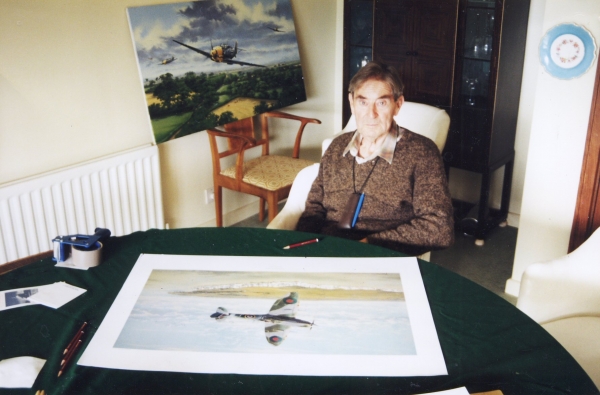
 Harbourne Stephen Signing the art print Fighting Lady by Graeme Lothian. The original painting Fighter General can be seen in the background. |
| Aircraft for : Harbourne Stephen | ||
| A list of all aircraft associated with Harbourne Stephen. A profile page including a list of all art prints for the aircraft is available by clicking the aircraft name. | ||
| Aircraft | Info | |
Spitfire 
Manufacturer : Supermarine Production Began : 1936 Retired : 1948 Number Built : 20351 | Spitfire Royal Air Force fighter aircraft, maximum speed for mark I Supermarine Spitfire, 362mph up to The Seafire 47 with a top speed of 452mph. maximum ceiling for Mk I 34,000feet up to 44,500 for the mark XIV. Maximum range for MK I 575 miles . up to 1475 miles for the Seafire 47. Armament for the various Marks of Spitfire. for MK I, and II . eight fixed .303 browning Machine guns, for MKs V-IX and XVI two 20mm Hispano cannons and four .303 browning machine guns. and on later Marks, six to eight Rockets under the wings or a maximum bomb load of 1,000 lbs. Designed by R J Mitchell, The proto type Spitfire first flew on the 5th March 1936. and entered service with the Royal Air Force in August 1938, with 19 squadron based and RAF Duxford. by the outbreak of World war two, there were twelve squadrons with a total of 187 spitfires, with another 83 in store. Between 1939 and 1945, a large variety of modifications and developments produced a variety of MK,s from I to XVI. The mark II came into service in late 1940, and in March 1941, the Mk,V came into service. To counter the Improvements in fighters of the Luftwaffe especially the FW190, the MK,XII was introduced with its Griffin engine. The Fleet Air Arm used the Mk,I and II and were named Seafires. By the end of production in 1948 a total of 20,351 spitfires had been made and 2408 Seafires. The most produced variant was the Spitfire Mark V, with a total of 6479 spitfires produced. The Royal Air Force kept Spitfires in front line use until April 1954. | |
| Squadrons for : Harbourne Stephen | ||
| A list of all squadrons known to have been served with by Harbourne Stephen. A profile page is available by clicking the squadron name. | ||
| Squadron | Info | |
166 Wing Country : UK Click the name above to see prints featuring aircraft of 166 Wing | 166 Wing Full profile not yet available. | |
No.605 Sqn RAF Country : UK Founded : 5th October 1926 Fate : Disbanded 10th March 1957 County of Warwick (Auxiliary) Nunquam dormio - I never sleep | No.605 Sqn RAF Formed on 5 October 1926 at RAF Castle Bromwich, 605 (County of Warwick) Squadron was originally a day bomber unit of the Auxiliary Air Force. recruiting in the Birmingham area. Initially equipped with DH.9As, it received Westland Wapitis in April 1930 and Hawker Harts in October 1934. The latter were replaced by Hawker Hinds in August 1936. On 1 January 1939 No. 605 squadron was redesignated as a fighter squadron and re-equipped with Gloster Gladiators., they moved to RAF Tangmere at the start of World War II with a mixture of 6 Hurricanes and 10 Gloster Gladiators. In 1940, the Squadron flew patrols over northern France and took part in the closing stages of the Battle of Britain. It then carried out escort duties and fighter sweeps until posted overseas. In November 1941, the Squadron flew off the carrier HMS Argus to Malta, where it was retained as part of the island's defences, prior to continuing its journey to the Far East. Arriving in Singapore too late to prevent its capture, it moved to Sumatra and then to Java, where they were caught up in the Japanese invasion. It operated any aircraft it could fly until it ceased to exist with its personnel either escaping in small groups or being captured. A new 605 Squadron was formed at RAF Ford on 7 June 1942. Initially equipped with Douglas Boston and Havocs in the intruder role, they were replaced with de Havilland Mosquitoes from February 1943. The Squadron continued to operate this type of aircraft until the end of the war and during this period they were tasked with destroying the German V1 Flying Bombs en route to England. The Squadron disbanded at Volkel Air Base on 31 August 1945; however, with the reactivation of the Royal Auxiliary Air Force, 605 Squadron was reformed as a night fighter squadron at RAF Honiley on 10 May 1946. Becoming a day fighter Squadron in July 1948, it flew de Havilland Vampire F.1s and Vampire FB.5s before finally being disbanded, along with all the flying units of the RAuxAF, on 10 March 1957. The Squadron Standard was awarded on 15 October 1953, but it was presented by HRH Princess Margaret on 11 March 1954. It is now laid up in the Parish Church of St Cuthbert of Lindisfarne, Castle Vale, which was built on the original site of RAF Castle Bromwich. | |
Return to Aviation Directory Search Home
|
Everything we obtain for this site is shown on the site, we do not have any more photos, crew lists or further information on any of the ships. COPYRIGHT NOTICE. ALL IMAGES DISPLAYED ON THIS WEBSITE ARE PROTECTED BY COPYRIGHT LAW, AND ARE OWNED BY CRANSTON FINE ARTS OR THEIR RESPECTIVE OWNERS. NO REPRODUCTION OR COPYING ALLOWED ON OTHER WEBSITES, BOOKS OR ARTICLES WITHOUT PRIOR AGREEMENT. |
|
Contact Details |
|
Sign Up To Our Newsletter!
This website is owned by Cranston Fine Arts. Torwood House, Torwoodhill Road, Rhu, Helensburgh, Scotland, G848LE Contact: Tel: (+44) (0) 1436 820269. Email: cranstonorders -at- outlook.com |
 |

