|
|
|
|
|
|

|
Naval History by Country :
|
|||||||||||||
| VIEW ALL OF OUR CURRENT ART SPECIAL OFFERS ON ONE PAGE HERE | |||
| NAVAL ART | AVIATION ART | MILITARY ART | SPORT ART |
|
|
Oskar Dinort |
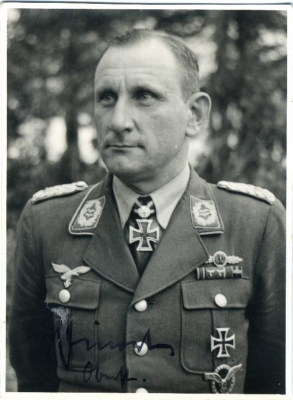 Name : Oskar Dinort Born : 22nd June 1901 Died : 27th May 1965 Awards : Knights Cross |
Oskar Dinort was born in Berlin-Charlottenburg. He volunteered for military service 1919 and joined the Freikorps der Gardekavallerie-Schützendivision and became a Fähnrich in the Infanterie-Regiment Nr. 2 in 1921. He was promoted to Leutnant in 1923 as well as an enthusiastic glider pilot. Promoted to Oberleutnant in 1928 he set a 14 hours and 43 minutes Gliding World Record. He won the Deutschlandflug in 1931, and participated in the second FAI International Tourist Plane Contest Challenge 1930 (10th place). Dinort was transferred to the still secret Luftwaffe in 1934 where he was posted to the "Reklamestaffel Mitteldeutschland" (Advertisement Staffel). His next posting was as a Hauptmann (captain) in the Stab of I./Jagdgeschwader 132 (JG 132—132nd Fighter Wing) and Gruppenkommandeur (group commander) of III./Jagdgeschwader 134 (JG 134—134th Fighter Wing) until he was called into in Reichsluftfahrtministerium (Ministry of Aviation) by Ernst Udet on 31 March 1935. After commanding I./Sturzkampfgeschwader 2 "Immelmann" (StG 2) in Poland, Major Dinort served as Geschwaderkommodore (wing commander) of StG 2 from October 1939 to October 1941. On 4 July 1940, in between the official dated given for the Battle of France and Battle of Britain, he led a highly successful attack on Convoy OA 178. He received the Knight's Cross of the Iron Cross with Oak Leaves in July 1941. During operations over Greece and Crete in April–May 1941 crews of StG 2 believed the blast effect of their bombs used against troops in Greece was greatly reduced because the bombs penetrated the ground before exploding. The solution was to fit 60 cm metal rods welded to the front of the bombs, with an 8 cm metal disc on the end of the rod. This arrangement became known as Dinortstäbe, (Dinort's rods—similar in concept to the daisy cutter) after the originator of the idea, Oskar Dinort, which caused the bombs to detonate some 30 cm above the ground, maximising their blast. On 15 October 1941 Dinort left StG. 2, taking up a staff position. In 1944 he was appointed to command 3. Fliegerschuldivision and inlate 1944 promoted to Generalmajor. Held by the British after the war ended, Dinort remained in captivity until 1947, He eventually settled in Dortmund after his release. he later worked in aviation research in Chile. |
Known Service Details : | |||||||
Squadron | Rank | Start of Service | End of Service | Known Dates | Aircraft | Airframes | Notes |
unknown | unknown | ||||||
Photos Submitted Through Our Directory |
 |
| Aircraft for : Oskar Dinort | ||
| A list of all aircraft associated with Oskar Dinort. A profile page including a list of all art prints for the aircraft is available by clicking the aircraft name. | ||
| Aircraft | Info | |
Ju87 
Manufacturer : Junkers Production Began : 1936 Retired : 1945 Number Built : 6500 | Ju87 By 1935 the German Luftwaffe was developing its first monoplane divebomber which entered production in 1936 as the Ju87 Stuka. The Stuka was to evolve into arguably the most successful single engine Axis divebomber of WW II. Utilizing a nearly vertical dive position the Stuka was stunningly accurate in the days when horizontal bombing was a relatively inaccurate science. The Ju87 was built for functionality and ruggedness. A fixed landing gear and exceptionally strong wing design were incorporated and no attempt was made to minimize protrusions. The Stuka was not designed for speed; it was an aerodynamic nightmare. The Stuka also incorporated a siren which when activated during a dive was designed to inflict psychological damage on the enemy below. The Ju87 was used with tremendous success in the Blitzkrieg attacks on Norway, Poland, Belgium, France, Holland, Yugoslavia, and Greece. Virtually unchallenged in the air during these Blitzkriegs the Stukas took a devastating toll on Allied ground and mechanized forces. Shipping was also vulnerable to the pinpoint attacks of the Stuka, and the Ju87 destroyed more Allied shipping than all other German aircraft put together during WW II. During Hitlers air attacks on Britain the Stukas reputation for invulnerability was shattered. Facing British Hurricanes and Spitfires the slower and less maneuverable Ju87s were destroyed in large numbers, eventually forcing their withdrawal from that conflict. Germanys attempt to develop an improved twin engine divebomber resulted in the introduction of the Messerschmitt 210 which was an unmitigated disaster. As a result, the Stuka remained in production longer than expected and the aircraft played a major role in Germanys surprise attack on Russia. In the first day of combat alone Stukas were credited with the destruction of over 700 Russian aircraft with minimal losses. One of Germanys top aces of WW II was Hans-Ulrich Rudel. Rudel flew over 2,500 combat missions in Ju87s, and was shot down on twelve occasions. Rudel was credited with destroying 519 tanks, 800 vehicles, 150 artillery pieces, one Russian battleship, one cruiser and one destroyer. Rudel was also credited with shooting down nine Russian aircraft in air-to-air combat. | |
| Squadrons for : Oskar Dinort | ||
| A list of all squadrons known to have been served with by Oskar Dinort. A profile page is available by clicking the squadron name. | ||
| Squadron | Info | |
LG2 Country : Germany Click the name above to see prints featuring aircraft of LG2 | LG2 Full profile not yet available. | |
Return to Aviation Directory Search Home
|
Everything we obtain for this site is shown on the site, we do not have any more photos, crew lists or further information on any of the ships. COPYRIGHT NOTICE. ALL IMAGES DISPLAYED ON THIS WEBSITE ARE PROTECTED BY COPYRIGHT LAW, AND ARE OWNED BY CRANSTON FINE ARTS OR THEIR RESPECTIVE OWNERS. NO REPRODUCTION OR COPYING ALLOWED ON OTHER WEBSITES, BOOKS OR ARTICLES WITHOUT PRIOR AGREEMENT. |
|
Contact Details |
|
Sign Up To Our Newsletter!
This website is owned by Cranston Fine Arts. Torwood House, Torwoodhill Road, Rhu, Helensburgh, Scotland, G848LE Contact: Tel: (+44) (0) 1436 820269. Email: cranstonorders -at- outlook.com |
 |

