|
|
|
|
|
|

|
Naval History by Country :
|
|||||||||||||
| VIEW ALL OF OUR CURRENT ART SPECIAL OFFERS ON ONE PAGE HERE | |||
| NAVAL ART | AVIATION ART | MILITARY ART | SPORT ART |
|
|
Robert Stanford-Tuck |
 Name : Robert Stanford-Tuck Born : 1st July 1916 Died : 5th May 1987 Service Number : 32306 Air Victories : 29.00 Awards : Distinguished Flying Cross Distinguished Flying Cross with 1 Bar Distinguished Flying Cross with 2 Bars Distinguished Service Order |
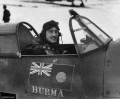
Bob Stanford Tuck was a flamboyant fighter pilot, Tuck was born in Catford, SE London. After a less-than-stellar school career he left St Dunstan's College, Catford in 1932 to join the Merchant Navy as a sea cadet (seaman's Discharge Number R112769) aboard the ss.Marconi from 19 May 1933 before joining the RAF on a short service commission as an acting pilot officer in 1935.[5] Following flying training, Tuck joined 65 Squadron in September 1935 as an acting probationary pilot officer. He became a pilot officer on probation in September 1936 and his pilot officer rank was confirmed in early 1937 (which was backdated to December 1936). On 17th January 1938 Tuck was involved in a Mid air collision flying Gladiator I K7940 he had to bail out of the aircraft over Ridgewood, near Uckfield, Sussex . The other Pilot was not so lucky, also of 65 Squadron in Gladiator K8014, Sgt Geoffrey Edwin Gaskell (24) was killed In September 1938 he was promoted to Flying Officer Tuck led his first combat patrol on 23 May 1940, over Dunkirk, claiming three German fighters shot down. The following day he shot down two German bombers and as aerial fighting intensified over the next two weeks his score rapidly mounted. Tuck was awarded the Distinguished Flying Cross (DFC) on 11 June and received it from King George VI at RAF Hornchurch on 28 June. His combat successes continued into July and August as the Battle of Britain gathered pace, although he himself was forced to bail out on 18 August. While attacking a formation of Junkers Ju 88s over Kent, he shot one down and damaged another. However, during the head on attack at Ju 88, when he overtook it, cannon shells hit his Spitfire and he was forced to bail out near Tunbridge Wells. He fell at Tucks Cottage, near Park Farm, Horsmonden. In another incident on 25 August Tuck's Spitfire was badly damaged during combat with a Dornier Do 17 bomber, which he destroyed 15 miles off the coast. His aircraft had a dead engine, but he glided it back to dry land and made a forced landing To the British public he was a hero in the mould of the knights of old, and today his name is legend. In the early stages of the Battle of Britain Bob fought with 92 Squadron flying Spitfires, quickly becoming one of the leading aces. Promoted to command 257 Squadron, now flying Hurricanes, Bob's dashing style of leadership inspired his pilots to great success. He went on to command the Duxford and Biggin Hill Wings, taking his personal score to 29 air victories before being shot down by ground fire over Northern France in 1942. Tuck then spent the next couple of years in Stalag Luft III at Żagań (Sagan), before making a number of unsuccessful escape attempts from several other prisoner of war camps across Germany and Poland. In company with the Polish pilot Zbigniew Kustrzyński, he finally escaped successfully on 1 February 1945 as his camp was being evacuated westwards from Russian forces advancing into Germany. Tuck's Russian, learned from his childhood nanny, was now crucial as he spent some time fighting alongside the Russian troops until he managed eventually to find his way to the British Embassy in Moscow. He eventually boarded a ship from Russia to Southampton, England. He died on 5th May 1987. |
COMBAT REPORTS |
The citation for his DFC, published in the London Gazette said "...this officer led his flight in company with his squadron on two offensive patrols over Northern France. As a result of one of these patrols in which the squadron engaged a formation of some 60 enemy aircraft, the Squadron Commander was later reported missing, and the flight commander wounded and in hospital. Flight Lieutenant Tuck assumed command, and on the following day led the squadron, consisting of only eight aircraft, on a further patrol engaging an enemy formation of fifty aircraft. During these engagements the squadron has shot down ten enemy aircraft and possibly another twenty-four. Throughout the combats this officer has displayed great dash and gallantry The official citation for his second DFC, published in the London Gazette reads: Flight Lieutenant Roland Robert Stanford TUCK, D.F.C. (37306). Since 11 June 1940, this officer has destroyed six enemy aircraft, and probably destroyed or damaged six more. One day in August, 1940, he attacked three Junkers 88's, destroyed two and damaged the third. Later in the month he intercepted two Ju 88's at 15,000 feet, and in a head-on attack, destroyed one. In a similar attack on the second, a cannon shell blew away his oil and glycol tank and a piece of his propeller, but he reached the coast and landed by parachute. In September, 1940, he shot down one Messerschmitt 110 and probably a Messerschmitt 109, and one week later destroyed a Bf 109 over the sea. Flight Lieutenant Tuck has displayed gallant and determined leadership |
Known Service Details : | |||||||
Squadron | Rank | Start of Service | End of Service | Known Dates | Aircraft | Airframes | Notes |
unknown | unknown | 1940 | |||||
unknown | unknown | ||||||
Pilot Officer | unknown | unknown | 17th January 1938 | On 17th January 1938 Tuck was involved in a Mid air collision flying Gladiator I K7940 he had to bail out of the aircraft over Ridgewood, near Uckfield, Sussex . The other Pilot was not so lucky, also of 65 Squadron in Gladiator K8014, Sgt Geoffrey Edwin Gaskell (24) was killed | |||
Artwork signed by this Pilot or Aircrew |
  Clipped Signature - Robert Stanford-Tuck. |   Those Valiant Few by Robert Taylor. (AP) |   Bob Stanford-Tuck Tribute Folio by Nicolas Trudgian. |
  Victory over Dunkirk by Robert Taylor. |   First of Many by Robert Taylor. |   Coming Home Together by Robert Taylor. |
  Return of the Few by Robert Taylor. |   Dawn Scramble by Robert Taylor. |
Artwork featuring the mounted signature of this Pilot or Aircrew |
  Close Combat by Ivan Berryman. (D) |
Photos Submitted Through Our Directory |
 |
Known Individual Aircraft : | ||||||||
Type | Serial | Codes | First Flew | Squadron History | Aircrew History | History Notes | Engine | Factory |
- | ||||||||
RS-T | - | no information | Merlin 45 | Castle Bromwich Aircraft Factory | ||||
FZ-L | 21/03/1939 | no information | Merlin II | Eastleigh | ||||
21/09/1939 | Merlin III | Eastleigh | ||||||
GR-P | 21/12/1939 | Merlin III | Eastleigh | |||||
29/12/1939 | Merlin III | Eastleigh | ||||||
28/03/1940 | Merlin III | Eastleigh | ||||||
| Aircraft for : Robert Stanford-Tuck | ||
| A list of all aircraft associated with Robert Stanford-Tuck. A profile page including a list of all art prints for the aircraft is available by clicking the aircraft name. | ||
| Aircraft | Info | |
Canberra 
Manufacturer : English Electric Production Began : 1951 | Canberra The English Electric Canberra first flew on Friday 13 May 1949 when its performance created a sensation. Such was the quality of the original design that in May 1951, when the first B2 Canberras entered service with No 101 Squadron at RAF Binbrook they could out manoeuvre all the fighters of the period and fly with impunity more than 10,000 feet above them. Operated by 17 airforces in more than 20 different variants, Canberras have been to war at Suez and in India, in Vietnam and the Falklands campaign, and in 1996 Canberra PR9s were engaged in operational reconnaissance flights over Bosnia and in other regions. It is widely and justifiably regarded as one of the greatest aircraft designs of all time. | |
Gladiator 
Manufacturer : Gloster Production Began : 1935 Retired : 1945 Number Built : 746 | Gladiator GLOSTER GLADIATOR: A continuation form the Gloster Gauntlet aircraft the Gloster Gladiator (SS37) becoming designated the F.7/30 was named Gladiator on the 1st July 1935. The first 70 Gladiators had Under wing machine guns (Vickers or Lewis) before the browning became standard The first aircraft arrived at Tangmere airfield on in February 1937 to no. 72 squadron. at the outbreak of world war two a total of 218 Gladiators had been received by the Royal air force with a total of 76 on active service. They served also in the Middle eats and in 1940 when Italy joined the war was nearly the only front line fighter in the middle east. Between 1939 and 1941. the Gloster Gladiator flew in many war zones. flying in France, Greece, Norway, Crete Egypt Malta and Aden. The Aircraft claimed nearly 250 air victories. It stayed in front line duties until 1942, then becoming fighter trainer, and other sundry roles. It continued in these roles until the end of world war two. The Naval equivalent the Sea Gladiator a short service in the Middle east and European waters. A Total of 746 aircraft were built of these 98 were Sea Gladiators.. Performance. speed: 250mph at 17,500 feet, 257 mph at 14,600 Range 430 miles. Armament: Two fixed .3-03 browning machine guns | |
Hurricane 
Manufacturer : Hawker Production Began : 1936 Number Built : 14533 | Hurricane Royal Air Force Fighter, the Hawker Hurricane had a top speed of 320mph, at 18,200 feet and 340mph at 17,500, ceiling of 34,200 and a range of 935 miles. The Hurricane was armed with eight fixed wing mounted .303 browning machine guns in the Mark I and twelve .303 browning's in the MKIIB in the Hurricane MKIIC it had four 20mm cannon. All time classic fighter the Hurricane was designed in 1933-1934, the first prototype flew in June 1936 and a contract for 600 for the Royal Air Force was placed. The first production model flew ion the 12th October 1937 and 111 squadron of the Royal Air Force received the first Hurricanes in January 1938. By the outbreak of World war two the Royal Air Force had 18 operational squadrons of Hurricanes. During the Battle of Britain a total of 1715 Hurricanes took part, (which was more than the rest of the aircraft of the Royal air force put together) and almost 75% of the Victories during the Battle of Britain went to hurricane pilots. The Hawker Hurricane was used in all theatres during World war two, and in many roles. in total 14,533 Hurricanes were built. | |
Spitfire 
Manufacturer : Supermarine Production Began : 1936 Retired : 1948 Number Built : 20351 | Spitfire Royal Air Force fighter aircraft, maximum speed for mark I Supermarine Spitfire, 362mph up to The Seafire 47 with a top speed of 452mph. maximum ceiling for Mk I 34,000feet up to 44,500 for the mark XIV. Maximum range for MK I 575 miles . up to 1475 miles for the Seafire 47. Armament for the various Marks of Spitfire. for MK I, and II . eight fixed .303 browning Machine guns, for MKs V-IX and XVI two 20mm Hispano cannons and four .303 browning machine guns. and on later Marks, six to eight Rockets under the wings or a maximum bomb load of 1,000 lbs. Designed by R J Mitchell, The proto type Spitfire first flew on the 5th March 1936. and entered service with the Royal Air Force in August 1938, with 19 squadron based and RAF Duxford. by the outbreak of World war two, there were twelve squadrons with a total of 187 spitfires, with another 83 in store. Between 1939 and 1945, a large variety of modifications and developments produced a variety of MK,s from I to XVI. The mark II came into service in late 1940, and in March 1941, the Mk,V came into service. To counter the Improvements in fighters of the Luftwaffe especially the FW190, the MK,XII was introduced with its Griffin engine. The Fleet Air Arm used the Mk,I and II and were named Seafires. By the end of production in 1948 a total of 20,351 spitfires had been made and 2408 Seafires. The most produced variant was the Spitfire Mark V, with a total of 6479 spitfires produced. The Royal Air Force kept Spitfires in front line use until April 1954. | |
| Squadrons for : Robert Stanford-Tuck | ||
| A list of all squadrons known to have been served with by Robert Stanford-Tuck. A profile page is available by clicking the squadron name. | ||
| Squadron | Info | |
No.257 Sqn RAF Country : UK Founded : 18th August 1918 Fate : Disbanded 31st December 1963 Burma Thay myay gyee shin shwe hti - Death or glory | No.257 Sqn RAF Full profile not yet available. | |
No.65 Sqn RAF Country : UK Founded : 1st August 1916 Fate : Disbanded 30th June 1992 East India Vi e tarmis - By force of arms | No.65 Sqn RAF Flew Mustangs from December 1943. | |
No.92 Sqn RAF Country : UK Founded : 1st September 1917 Fate : Disbanded 1st October 1994 East India Aut pugna aut morere - Either fight or die | No.92 Sqn RAF 92 Squadron was formed in the First World War, as a squadron of the Royal Flying Corps, on 1st September 1917. It flew Pups, Spads and SE5s during the war, becoming an RAF squadron on the formation of the RAF on 1st April 1918, before being disbanded on 7th August 1919. On the outbreak of hostilities of World War Two, 92 Sqn reformed on 10th October 1939, flying Blenheims before converting to Spitfires. It transferred to North Africa, and for some time flew as part of 244 Wing RAF. After the war, the squadron was disbanded on 30th December 1946. On 31st January 1947, the former 91 Squadron was redesignated 92 Squadron, flying the Meteor before re-equipping with the Sabre and then the Hunter. While flying the Hunter in 1960, the squadron was designated as the RAF's aerobatic squadron, with the name Blue Diamonds, a name the squadron carried on after tranferring to the Lightning. The squadron then re-equipped with Phantoms, before being disbanded on 1st July 1991. It was reformed from a rserve squadron on 23rd September 1992, and became No.92 (Reserve) Squadron, flying the Hawk aircraft before being disbanded once more on 1st October 1994. | |
Return to Aviation Directory Search Home
|
Everything we obtain for this site is shown on the site, we do not have any more photos, crew lists or further information on any of the ships. COPYRIGHT NOTICE. ALL IMAGES DISPLAYED ON THIS WEBSITE ARE PROTECTED BY COPYRIGHT LAW, AND ARE OWNED BY CRANSTON FINE ARTS OR THEIR RESPECTIVE OWNERS. NO REPRODUCTION OR COPYING ALLOWED ON OTHER WEBSITES, BOOKS OR ARTICLES WITHOUT PRIOR AGREEMENT. |
|
Contact Details |
|
Sign Up To Our Newsletter!
This website is owned by Cranston Fine Arts. Torwood House, Torwoodhill Road, Rhu, Helensburgh, Scotland, G848LE Contact: Tel: (+44) (0) 1436 820269. Email: cranstonorders -at- outlook.com |
 |

